
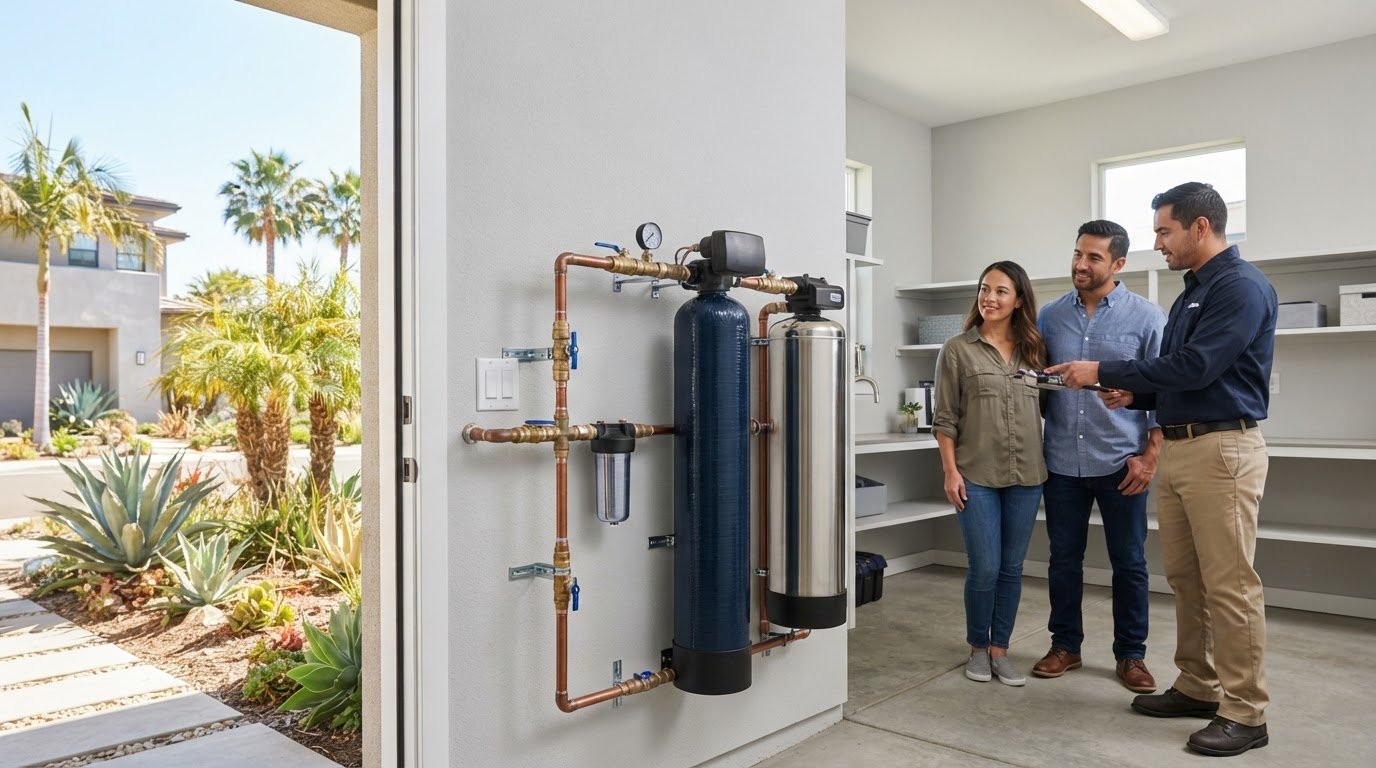
A filter at one faucet treats water only at that tap. A whole-house water filter in Southern California treats water at the main line as it enters your home, before it reaches faucets and appliances. A properly matched system can reduce chlorine, chloramine, sediment, and other particles throughout the home. It does not remove hardness minerals such as calcium and magnesium, which require a softener or conditioner.
It’s natural to want better-tasting water and help keeping your home’s plumbing and appliances in good condition. This guide explains how whole-house filtration compares with point-of-use filters, what it can and can’t address, and how filtration media affect chlorine, chloramine, sediment, and particles. You’ll also learn what to consider when choosing a system for your household, including water quality, household use, and ongoing maintenance, so you can understand which approach fits your needs.
A whole-house filter treats water at the point of entry, before it reaches connected faucets and appliances. California permit requirements depend on local codes and the work involved, so plumbing alterations may require local permit review.
A point-of-entry filtration system connects to the main water line where it enters your home. It treats water for showers, laundry, kitchen taps, and appliances. A point-of-use filter treats water at one location, such as a drinking-water faucet. Choose by identifying where treatment matters most: throughout the plumbing or at a particular tap. For example, a kitchen-only concern may call for point-of-use treatment, while household-wide chlorine reduction calls for point-of-entry coverage.
Compare the full cost of ownership, not just the system’s purchase price. Factor in installation, replacement media, and ongoing maintenance, which vary with system design, incoming water, and household use. Match the media and capacity to those conditions, and follow the maintenance schedule so depleted media does not undermine performance.
Filtration and softening solve different water problems. Whole-house filtration can reduce chemical contaminants, tastes, and odors, while a softener removes hardness minerals such as calcium and magnesium. Hard water affects over 85% of Southern California homes. If your home uses a softener, a filter can also protect its resin from chlorine damage.
Start by identifying your water concern, deciding whether treatment should serve one tap or the whole home, and considering compatibility with your plumbing and any softener. A whole-house water filter in Southern California should match the water entering your property, not simply the home’s size. This helps align treatment goals with long-term performance.
Yes. Activated carbon filtration can reduce chlorine compounds and musty odors, improving water’s taste and smell. The right treatment depends on the water-quality concerns you want to address and where you want filtered drinking water.
Whole-house water filters for Southern California homes use different media and configurations. Carbon filtration can address chlorine-related taste and odor, while sediment filtration captures particles. Other systems target specific water concerns. No single setup suits every home: municipal and well water require different considerations, and testing helps identify what treatment is needed.
For municipal water, consider chlorine or chloramine and sediment concerns. For well water, test first so treatment matches the contaminants identified. Well-water needs vary by source, so choosing a filter without that information may miss the target. Testing can also distinguish taste and odor concerns from hardness, which filtration alone does not remove.
Elite, Classic, Eco, and Waterboy are labels to compare by specific model, not assumptions based on the name. Check which contaminants each system treats, its capacity for household use, and its replacement-media schedule. If a system claims Gold Seal certification, verify that the exact model and performance claim fall within the certification. Specifics matter more than a broad label.
System service life varies with maintenance and timely media replacement. A whole-house filter can last 10-15+ years with professional maintenance and timely media replacement. Compare the ongoing replacement needs alongside capacity, since media condition affects performance. For clearer drinking water and fewer taste or odor distractions, align the system with test results and household use; explore water filtration options as a next step.
To choose and vet a licensed installer, focus on the plumbing work involved, the system’s capacity, maintenance requirements, and a clear explanation of how the proposed treatment addresses your water test. The risks of a poor match include untreated target concerns, inadequate flow, and avoidable maintenance problems. Ask for the system’s treatment purpose and replacement plan in writing before proceeding.
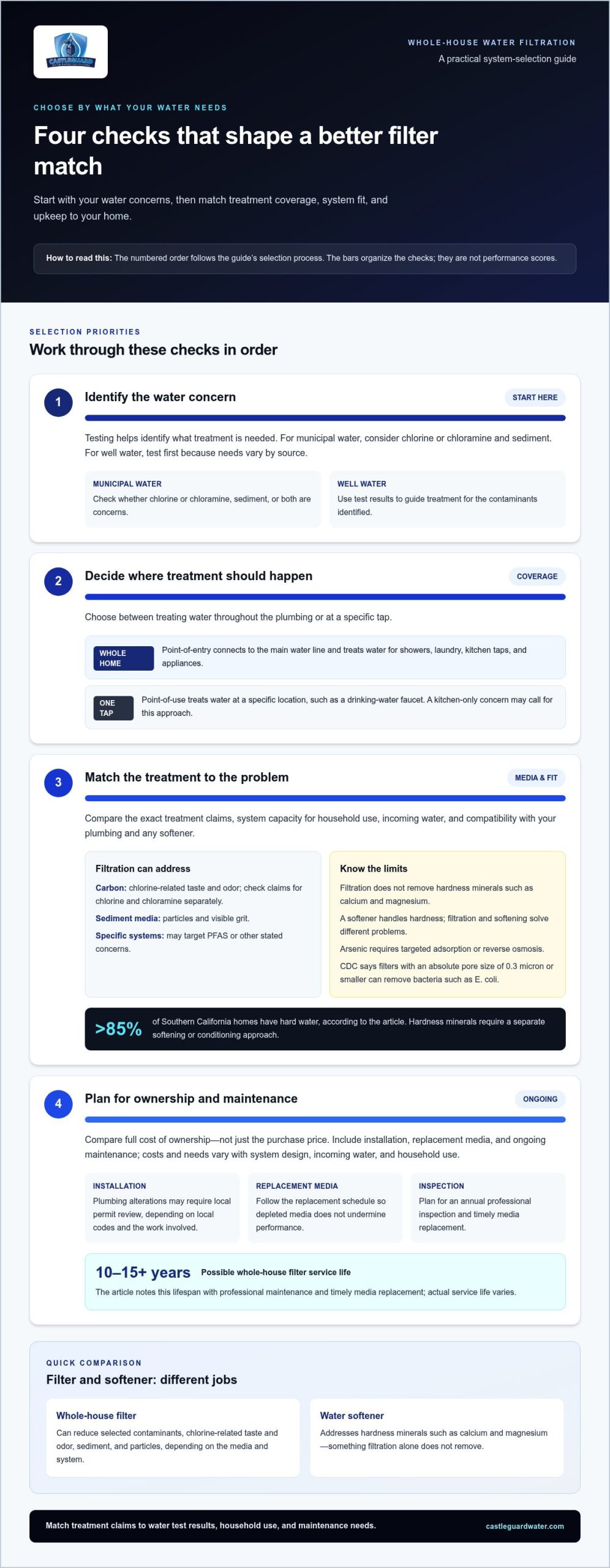
Whole-house filtration can reduce chlorine and target PFAS, but it doesn’t remove hardness minerals; a water softener handles calcium and magnesium. Arsenic requires targeted adsorption or reverse osmosis, while the Centers for Disease Control and Prevention says filters with an absolute pore size of 0.3 micron or smaller can remove bacteria such as E. coli.
Activated carbon can reduce chlorine compounds, but chlorine and chloramine are different disinfectants. Check the filter’s specific claims for each instead of assuming chlorine reduction means chloramine reduction. Granular activated carbon can reduce PFAS by trapping chemicals as water passes through, according to the U.S. Environmental Protection Agency. For volatile organic compounds, look for a system designed and rated for the specific compounds of concern.
Point-of-entry filtration treats water flowing through household plumbing, including water used at showers and faucets. The chosen media and its stated reduction claims therefore matter for bathing water as well as drinking water. Carbon performance depends on system design and maintenance, so follow the replacement schedule and compare the exact claims with your treatment goals.
Sediment filters capture particles as water flows through them, helping address visible grit or suspended particles before they reach faucets and appliances. Match the filter to the particles you want to capture and the system’s intended flow. A sediment filter does not remove dissolved chemicals just because the water looks clearer afterward.
Use a simple sequence: identify the concern, choose media with a matching reduction claim, and maintain or replace it as directed. Sediment filtration may address particles, while carbon targets certain chemical compounds. Check that any standard or certification claim applies to the exact system and contaminant, not just the product category. A whole-house filter also does not replace a softener for hardness. Each treatment stage addresses different contaminants or particles.
Water enters your home through the main line, then travels to faucets, showers, the water heater, and appliances. Filtration at that entry point can reduce sediment and selected chemical compounds before they move through household plumbing. This can help limit particle buildup in fixtures and reduce chlorine exposure for downstream equipment.
Southern California water hardness deserves separate attention. Much of the region’s water exceeds 180 mg/L of hardness. Calcium and magnesium minerals can contribute to scale on showerheads, faucets, and heating surfaces. A standard whole-house filter doesn’t remove those minerals, so filtration alone won’t prevent hardness-related deposits. Homeowners concerned about scale need to distinguish filtration from water softening or conditioning.
Match each treatment stage to a specific issue. Sediment filters capture particles, carbon media can reduce chlorine compounds, and softeners address hardness minerals. For example, sediment reduction may help if grit collects at a faucet. If scale forms around a water heater, hardness treatment is the relevant consideration.
Identify where deposits or particles appear, then match the symptom to the treatment goal. Capturing sediment before it reaches appliances can help reduce particle accumulation in screens and valves. Reducing chlorine before water reaches a softener can help protect its resin from chlorine damage. These are separate benefits, not functions of a single filter.
Maintenance matters, too. Follow the system’s media replacement schedule and keep the plumbing connections accessible for service. A clogged sediment stage can restrict water flow, while exhausted carbon media may no longer perform as intended. Review your home water treatment options to match filtration goals with plumbing and appliance needs.
For homeowners with municipal water, CastleGuard’s City System is a whole-home filtration option. It can be a starting point for addressing concerns such as chlorine, sediment, and taste, while hardness treatment remains a separate consideration.
For private wells, CastleGuard offers Well Water Systems. Ultraviolet Systems and Drinking Systems address other treatment needs, including point-of-use and drinking-water treatment. Identifying your water source and main concern helps narrow the options.
Choose a system based on the water entering your home and your treatment goal. Contact CastleGuard to discuss the City System and find an option suited to your household’s water needs.
Turn your water concerns into a clear treatment goal. Consider where you want treated water, which issues matter most to your household, and what level of ongoing maintenance is practical. This gives you a useful starting point for choosing a whole-house water filter in Southern California, rather than selecting equipment by name alone.
CastleGuard offers a City System for municipal water, Well Water Systems for private wells, and Ultraviolet Systems for other treatment needs. The right option depends on your water source and goals. Consider how each system aligns with your home and priorities instead of assuming every household needs the same treatment.
Ready to take the next step? Contact CastleGuard about water filtration and discuss a path that suits your household. With a clear goal and a system suited to it, you can make a thoughtful choice for your home’s water.
They can reduce reliance on single-use bottled water, and some designs use fewer resources during operation. Switching to filtered tap water can help an average household eliminate over 1,500 plastic bottles per year. CastleGuard’s upflow carbon and salt-free systems use no electricity, drain lines, or wastewater. Consider filter replacements and system operation together when weighing environmental impact, since these factors vary by treatment type.
No. Standard filtration does not remove calcium and magnesium hardness minerals. A water softener uses ion exchange to remove them, while a salt-free conditioner treats hardness minerals without removing them. If scale appears on a kettle or shower fixture, filtration media alone will not address the cause. Choose equipment based on whether you want minerals removed or scale formation addressed.
For municipal water, find the annual water quality report from the utility serving your address and note the listed contaminants and measured levels. Compare the findings with your priorities, such as taste, odor, or sediment. Private wells need testing of the well water itself, since a nearby utility report does not describe your source. Use results to choose treatment for specific concerns rather than relying on general claims.
The total cost depends on the treatment type, system capacity, plumbing layout, and any changes needed at the main water line. Include equipment, installation labor, and future replacement media in your budget. A straightforward connection differs from a project involving plumbing changes or multiple treatment stages. Compare the full scope and ongoing upkeep, not just the initial equipment cost.
Carbon filters target selected chemical compounds and taste or odor concerns; sediment filters capture particles. Water softeners remove calcium and magnesium through ion exchange. Reverse osmosis is commonly used at a drinking-water tap, rather than treating every household outlet, and can remove up to 97% of dissolved minerals. The right combination depends on your water test and whether treatment is needed throughout the home or at one tap.
Size the system around peak simultaneous water use, not household size alone. Consider fixtures that may run together, such as a shower, washing machine, and kitchen faucet, along with the plumbing’s capacity. CastleGuard carbon models are rated from 10 to 25 GPM. Select a capacity that supports expected flow while allowing for the system’s treatment design and maintenance needs.