
The option that avoids salt may not actually soften your water. If you’re looking for an eco friendly water softener alternative, that distinction matters: salt-free conditioners generally leave calcium and magnesium in the water while aiming to manage scale buildup.
This can mean less salt handling and no brine discharge from salt-based regeneration, but it may not provide mineral removal or the feel of softened water. The right fit depends on what’s in your water, where scale is causing trouble, and which maintenance trade-offs work for your household.
This guide compares salt-free conditioning with other approaches, including what each can and can’t do and how to match a system to your water and plumbing. CastleGuard Water Systems offers salt-free conditioner kits as one whole-home option to consider. Use the practical criteria below to choose based on your home’s needs, not the eco-friendly label alone.
Start by defining the trade-off you want to change. Are you trying to avoid salt handling, reduce regeneration water use, limit scale, or remove hardness minerals? These are different goals, and an alternative may address one without addressing the others. Your water’s hardness and source, whether municipal or well, help identify what a treatment system needs to do. Review a reliable water test or available water-quality information before comparing systems.
Not in the same way as a conventional ion-exchange softener. Ion exchange removes calcium and magnesium hardness minerals from water. A salt-free conditioner is designed to address scale formation while leaving those minerals in the water. Softening removes hardness minerals; conditioning focuses on managing how minerals form scale. Don’t assume a conditioner will remove hardness or produce the same water characteristics as a softener. The overview of Water softening explains these different treatment approaches.
There’s no single measure that makes a system the right environmental choice for every home. Compare the full process: salt use and discharge, water used during regeneration, and the maintenance or replacement of filters and media. A salt-free system avoids salt-based regeneration, but still needs upkeep. An ion-exchange system removes hardness minerals, while its salt and water use depend on the system and household use.
Choose according to your main concern. If scale is the problem, compare scale-focused conditioning with mineral removal. If the issue is drinking-water taste, a point-of-use system may be more relevant than treating the whole home. The best eco friendly water softener alternative is the one that fits your water, treatment goal, and maintenance preferences, not simply the one with the greenest label.
Each option addresses a different water concern. Choose by the issue you want to treat, not just by whether a system is labeled “eco-friendly.” Water hardness relates to the amount of dissolved calcium and magnesium, while scale, drinking-water taste, and other water-quality concerns may call for different approaches.
| Approach | Treatment goal | Potential trade-off | May suit you if… |
|---|---|---|---|
| Salt-free conditioning | Condition water with a focus on managing scale, without conventional salt-based softening. | It doesn’t remove hardness minerals or promise the feel of softened water; maintenance depends on the system. | You want a scale-focused approach without salt-based regeneration. |
| Ion-exchange softening | Remove calcium and magnesium hardness minerals. | Uses salt and water during regeneration and requires ongoing attention. | Mineral removal is your priority and you’re prepared for system upkeep. |
| Reverse osmosis | Treat water at a drinking-water outlet. | Point-of-use treatment addresses selected water, not automatically the whole home; system upkeep is still needed. | Your concern is drinking water rather than scale throughout the plumbing. |
| Filtration | Target particular taste or water-quality concerns, depending on the filter. | Filtration isn’t a direct substitute for whole-home softening, and filters need replacement. | You’re focused on water at a specific outlet or a particular filtration goal. |
Conditioning may suit homeowners who want to address scale without conventional softening. Results and maintenance needs vary by system and water conditions, so don’t assume it will prevent all scale or make water feel soft. CastleGuard offers salt-free conditioner kits as a whole-home option to compare with your treatment goals.
Choose filtration or reverse osmosis for a drinking-water goal, not as a stand-in for treating hardness throughout your home. A point-of-use system treats water at its selected outlet; whole-home treatment serves a different purpose. The most suitable eco friendly water softener alternative is the one that matches your treatment goal and the water you actually use.
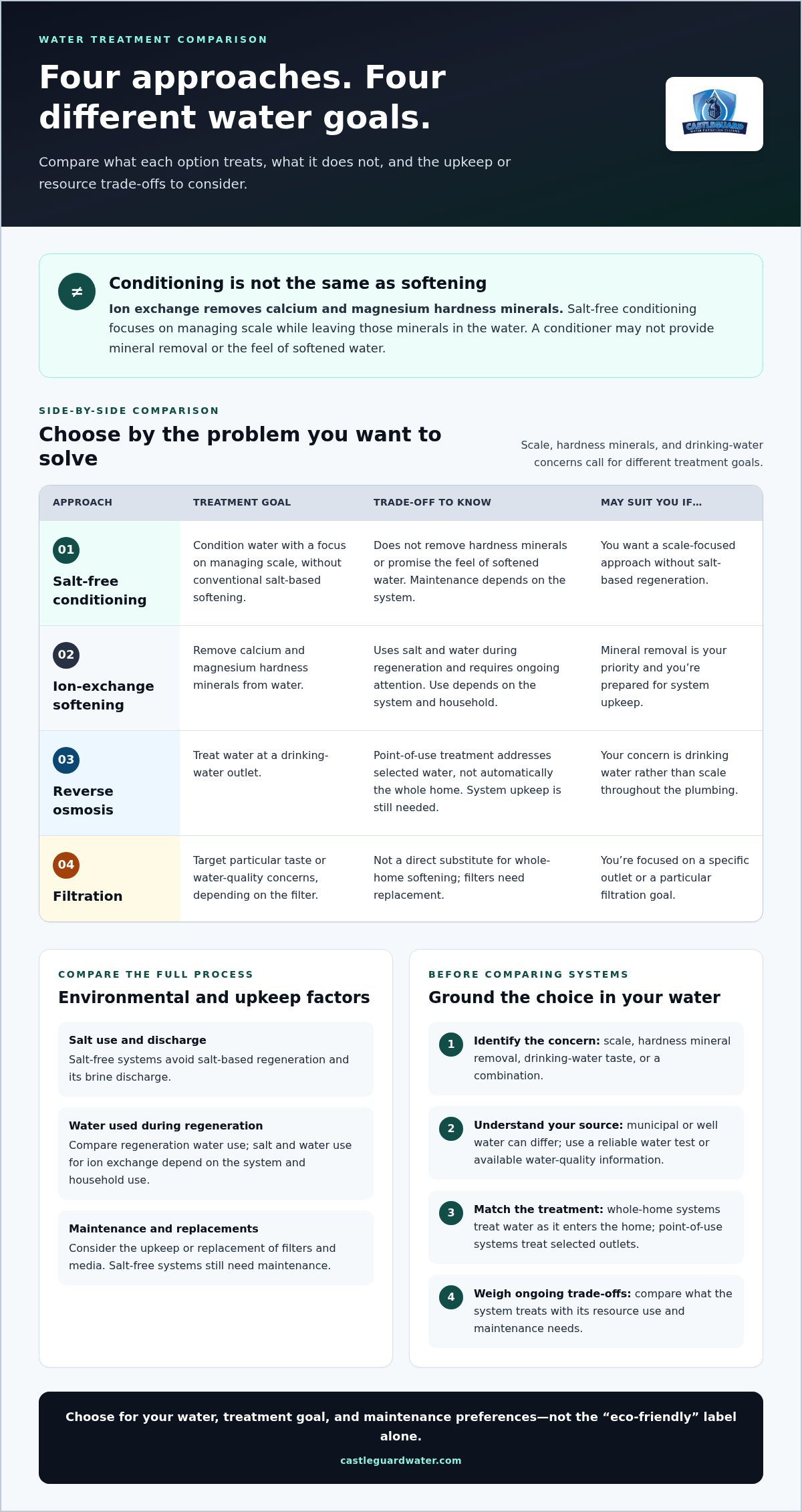
Start with the result you want: less scale, removal of hardness minerals, better-tasting drinking water, or a combination. These concerns aren’t interchangeable, and one system may not address them all. A reliable water test or available water-quality information can help clarify what’s present before you choose an eco friendly water softener alternative.
Hardness, taste, and other water concerns call for different treatment goals. City and well water can also differ, so base your decision on your own water source and its quality information rather than assumptions about your area. For a closer look at how salt-free conditioning works, read our salt-free water conditioner guide.
Look beyond an “eco-friendly” label. Compare what the system treats with the resources and upkeep it involves. Whole-home systems address water as it enters the home; point-of-use systems treat selected outlets. Salt-free conditioning focuses on scale management, while ion exchange removes hardness minerals. Drinking-water filtration has a different purpose.
| Approach | Treatment purpose | Environmental and maintenance considerations |
|---|---|---|
| Salt-free conditioning | Focuses on managing scale without removing hardness minerals. | Avoids salt-based regeneration; check the system’s media or filter upkeep and water suitability. |
| Ion-exchange softening | Removes hardness minerals. | Uses salt and water during regeneration; account for ongoing replenishment and discharge. |
| Point-of-use treatment | Targets drinking water at selected outlets. | Doesn’t treat the whole home by itself; factor in filter or system maintenance. |
For more on scale-focused options, see our salt-free scale prevention guide. CastleGuard’s salt-free conditioner kits are one whole-home option for homeowners comparing salt-free approaches.
A careful choice starts with your home’s water and priorities, not a label. Use this process to narrow your options:
Homeowners in Southern California, Nevada, Arizona, Texas, and Florida shouldn’t assume that state or regional location alone determines the right treatment. Your water source and household test results are more useful guides. Review the information for your own home, then choose a system based on the concern you want to address.
A salt-free option may focus on scale without removing hardness minerals. If mineral removal is essential to your goal, that difference matters. CastleGuard offers salt-free conditioner kits and whole-home water protection solutions, along with automatic filter deliveries for replacement needs. Customer support is available Monday through Friday. Compare the system’s treatment purpose and maintenance needs with your household priorities.
The right eco friendly water softener alternative is one that fits your water, household goals, and willingness to maintain it. Explore CastleGuard water treatment solutions to compare whole-home options.
The best eco friendly water softener alternative addresses your household’s actual water concerns. Keep the key distinction in mind: salt-free conditioners may focus on scale without removing hardness minerals, while other approaches serve different treatment goals. Use water-quality information to guide your choice, then weigh system coverage and ongoing maintenance.
CastleGuard offers salt-free conditioner kits and whole-home water protection solutions for homeowners in Southern California, Nevada, Arizona, Texas, and Florida. Its product line also includes filtration, softeners, ultraviolet and drinking water systems, and replacement media kits.
Explore CastleGuard water treatment solutions and choose an approach that fits your water, home, and priorities.
A salt-free conditioner may suit homeowners seeking a different approach to scale management, but it isn’t guaranteed to have a lower environmental impact in every home. Compare its treatment purpose, maintenance, and resource use with other systems, including salt use and water used during regeneration. Conditioning generally doesn’t remove hardness minerals as ion exchange does, so review water-quality information and documented treatment claims before choosing.
Don’t assume it does. Salt-free conditioners and conventional ion-exchange softeners use different treatment approaches, and conditioning isn’t automatically mineral removal. If removing calcium and magnesium is your priority, make that goal clear before comparing systems. Check the system’s documented treatment purpose and use reliable water-quality information to guide your decision. This helps you choose an approach suited to your water rather than its label.
There’s no single option that’s best for every household. The most suitable eco friendly water softener alternative depends on your water and treatment goal, along with factors such as salt discharge, water use, and maintenance. For homeowners in Southern California, Nevada, Arizona, Texas, and Florida, local water-source information and household test results are more useful than assuming water quality based on state alone.
Sometimes a filter can address a specific drinking-water or water-quality concern, but filtration isn’t automatically a substitute for hardness treatment. First identify whether you’re concerned about scale, mineral hardness, taste, or another issue. A point-of-use filter treats water at selected outlets rather than automatically treating the whole home. Some households may need different approaches for separate goals, depending on their water and needs.