
Imagine welcoming guests into your home, only to have a thick, rotten-egg odor greet them at the door. You’ve scrubbed the floors and lit candles, but the moment you fill a glass or start the dishwasher, that unmistakable smell returns. It’s more than just an embarrassment; it makes you worry if the water your children drink is truly safe. At CastleGuard Water Systems, we know you want to protect your family from these hidden nuisances. Learning how to remove sulfur smell from well water is the first step toward a healthier, more comfortable home.
You aren’t alone in this frustration, as many well owners across the Southwest and Florida face these same “nuisance” contaminants. This guide will show you exactly how to identify the source of the odor and discover the most effective, permanent solutions for your plumbing. We will walk through a simple diagnostic test, compare modern filtration options, and explain how a “set it and forget it” system can provide the lasting peace of mind you’ve been looking for.
The unmistakable scent of rotten eggs isn’t just a nuisance; it’s the result of a chemical process happening deep within your water supply. This odor is caused by hydrogen sulfide gas (H2S), which is often produced by sulfate-reducing bacteria. These microorganisms thrive in the deep, low-oxygen aquifers common across Arizona and Texas. Learning how to remove sulfur smell from well water starts with identifying this gas. While the gas creates the smell, it’s distinct from sulfate minerals. Sulfates don’t usually smell, but they can leave a bitter, medicinal taste and even cause a laxative effect if concentrations are high enough. Persistent sulfur odors act as a warning that your well water needs a professional guardian to ensure your household stays protected.
While low levels of hydrogen sulfide are generally considered an aesthetic issue rather than a health crisis, the presence of the gas means your water source is vulnerable. Beyond the smell, sulfur gas is surprisingly aggressive toward your home’s infrastructure. It acts as a corrosive agent that eats away at copper plumbing and brass fixtures over time. You might also notice your silver jewelry or silverware tarnishing much faster than normal. Protecting your family means addressing these hidden costs before they lead to expensive pipe repairs.
Homeowners in Florida and the Southwest face unique hurdles because of local geology. The limestone and deep aquifers in these regions often contain high levels of elemental sulfur and organic matter. In states like Nevada and Southern California, the intense heat can actually speed up the release of gas from the water as it travels into your home. This makes it even harder to remove sulfur smell from well water without a specialized treatment strategy tailored to these specific climates. Understanding these regional factors is the essential first step to securing fresh, clean water for your home.
Before you can effectively remove sulfur smell from well water, you need to identify exactly where the gas is entering your plumbing. You don’t need a professional lab to start this process; you can perform a simple DIY “Sink Test” at any faucet in your home. This methodical approach helps you distinguish between a problem with your groundwater and a mechanical issue within your home’s appliances.
Your water heater typically contains a magnesium sacrificial anode rod. This rod is designed to protect the tank from corrosion, but it can react with sulfate in the water to create hydrogen sulfide gas. If your test points to the hot water only, you might consider replacing the rod with an aluminum-zinc alloy version. However, if you want to permanently remove sulfur smell from well water across all taps, it’s time to install a professional well water treatment system to act as a comprehensive shield for your home.
While the sink test is a great start, certain signs demand a deeper look. If the odor is accompanied by cloudiness or a sharp metallic taste, a certified laboratory analysis is essential. Following EPA private well testing recommendations ensures you are checking for coliform bacteria alongside sulfur. This verification provides the total peace of mind that your water is safe for your children. For many homeowners, a CastleGuard Well Water System provides the ultimate “set it and forget it” solution to these ongoing maintenance worries.
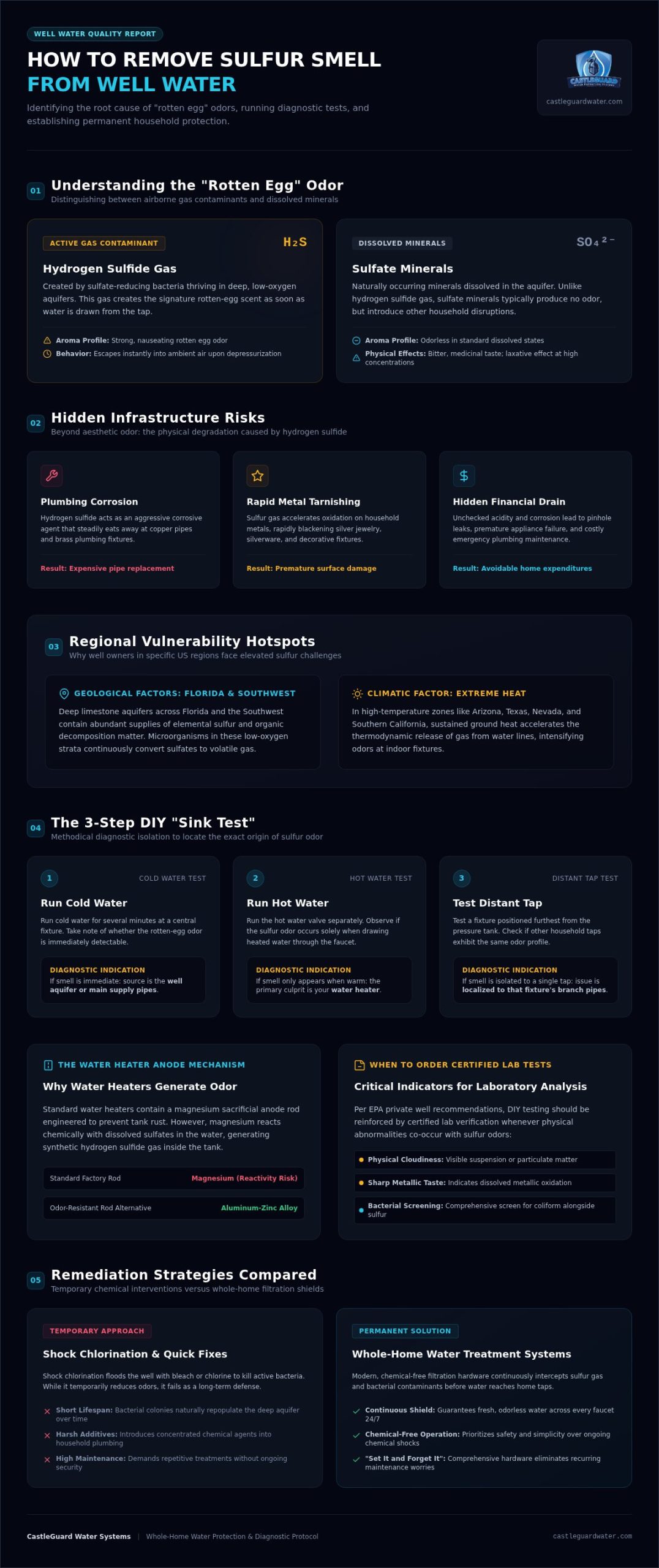
When you decide to remove sulfur smell from well water, you’ll likely encounter two paths: temporary “quick fixes” or permanent filtration hardware. While the quick fix seems easier, it rarely provides the long-term security your family needs. Modern homeowners increasingly prefer chemical-free solutions that prioritize safety and simplicity over harsh additives. Understanding how these technologies work allows you to choose a system that acts as a reliable guardian for your household’s health.
Many homeowners try shock chlorination, which involves pouring concentrated bleach down the well casing. According to the Penn State Extension guide to treating hydrogen sulfide in well water, this is often a “band-aid” solution. It typically only masks the odor for one to eight weeks before the bacteria recolonize the aquifer. Additionally, high chlorine levels can be incredibly harsh on your home’s pipes and rubber seals, potentially causing leaks or damaging expensive well components.
For a reliable result, oxidation is the professional standard. This process uses air or specialized media to turn dissolved gas into solid particles that can be physically trapped and washed away. Air Injection Oxidation (AIO) is a popular choice in 2026 because it requires no toxic chemicals, making it much safer for households with children. Activated carbon filtration is also highly effective for low-to-moderate gas levels, as it traps odor molecules within its porous surface. A professional well water treatment system combines these technologies to provide a permanent shield. If you’re tired of the smell, see how CastleGuard Water Systems can restore purity to your home.
You’ve identified the source and understand the technology needed to remove sulfur smell from well water. Now, you need a system that works tirelessly in the background. CastleGuard Water Systems provides a professional-grade Well Water System that acts as a comprehensive shield for your home. Unlike small, point-of-use filters, this is a whole-home solution. It ensures that fresh, odorless water flows from your kitchen sink, your shower, and even your laundry room, protecting every tap your family touches.
Maintenance is often the biggest concern for well owners, but it doesn’t have to be a burden. CastleGuard simplifies the process with automatic media replacement kits and Carbon Kits delivered right to your door. These “set it and forget it” solutions remove the guesswork from home maintenance. You can enjoy pure water without having to track schedules or handle heavy, messy chemicals. It’s about making your home environment simpler and safer.
Our team offers US-based customer support with specific expertise in the unique water conditions of Southern California, Nevada, Arizona, Texas, and Florida. We design our hardware for longevity, ensuring it stands up to the aggressive nature of sulfur gas. This protection extends beyond your health; it also safeguards your dishwasher, washing machine, and water heater from premature corrosion. By choosing CastleGuard, you’re partnering with a knowledgeable guide who understands the challenges of local aquifers. Many well owners also find it helpful to pair their sulfur removal system with the best water softener for well water to address iron, manganese, and hardness minerals in a comprehensive multi-stage defense strategy. For those relying entirely on private groundwater, exploring dedicated water purification for rural homes can help you build a complete whole-home defense against every contaminant your aquifer may harbor.
Every well is different, and your solution should be too. Whether your well is shallow or deep, or your odor is faint or overwhelming, the right system configuration is key to long-term success. We invite you to contact our support team for a consultation tailored to your specific well depth and odor intensity. Taking this final step is an investment in your family’s well-being. Clean, fresh-tasting water provides the ultimate peace of mind for you and your loved ones.
You don’t have to live with the embarrassment of a sulfurous home or worry about the corrosive impact of gas on your plumbing. By using the simple sink test to locate the source and moving beyond temporary chemical shocks, you’ve already taken the most important steps toward a cleaner household. The path to permanently remove sulfur smell from well water is clear; it requires a reliable filtration strategy that works for your family every single day without the need for harsh chemicals.
CastleGuard Water Systems is here to act as your knowledgeable guide. We provide specialized solutions tailored to the unique groundwater challenges found in Florida and the Southwest. With our US-based customer support available Monday through Friday and automatic replacement media delivery, we take the guesswork out of maintenance so you can focus on what matters most. It’s time to reclaim your peace of mind and enjoy fresh, pure water from every tap. Protect your home today with a CastleGuard Well Water System and experience the difference that professional-grade protection makes for your loved ones.
Bathing in water with a rotten egg odor is generally safe, as the hydrogen sulfide gas is usually an aesthetic nuisance rather than a health risk. However, the gas can be absorbed by your skin and hair, leaving the scent behind long after your shower. For families in the Southwest and Florida, this smell often points to a lack of protection that could eventually cause minor skin or eye irritation.
A standard carbon pitcher filter isn’t powerful enough to remove sulfur smell from well water. These small devices are designed for city water and lack the capacity to neutralize the high concentrations of hydrogen sulfide gas found in deep wells. To protect your home, you need a dedicated Well Water System that treats the water at the main line before it reaches your kitchen or bathroom taps.
Maintenance is simple and predictable with a CastleGuard system. We offer automatic replacement media deliveries and Carbon Kits to remove the guesswork for homeowners. This “set it and forget it” approach ensures your hardware remains a vigilant guardian for your home. Our US-based customer support is available Monday through Friday to help you manage your schedule, ensuring you never have to deal with the odor returning unexpectedly.
No, a salt-free conditioner is designed to prevent mineral scale, not to remove sulfur smell from well water. While conditioners are essential for protecting your pipes from hard water damage, they don’t contain the specific media needed to trap gas molecules. You must pair your conditioner with a filtration system that uses oxidation or catalytic carbon to effectively shield your family from persistent rotten egg odors.
Ignoring the odor can lead to expensive, long-term damage to your home’s infrastructure. Hydrogen sulfide gas is highly corrosive; it eats away at copper pipes, brass fixtures, and the internal components of your water heater. In regions like Arizona and Texas, this gas can also cause rapid tarnish on silver and stainless steel. Over time, these corrosive reactions may lead to pinhole leaks that threaten your family’s security. Homeowners who depend entirely on private wells may benefit from reviewing a comprehensive guide to water purification for rural homes to understand the full range of contaminants that can threaten their water supply alongside hydrogen sulfide.