
When homeowners think about water treatment, they often think about chlorine, hardness, iron, bacteria, or other contaminants they may have heard about in their water. But there is another important category that can easily be overlooked: sediment and particulate matter.
That’s why most whole-house water treatment systems include a sediment filter as one of the first stages of treatment.
A sediment filter is designed to capture non-dissolved solid particles suspended in your water before they travel farther into your home’s plumbing or water treatment equipment.
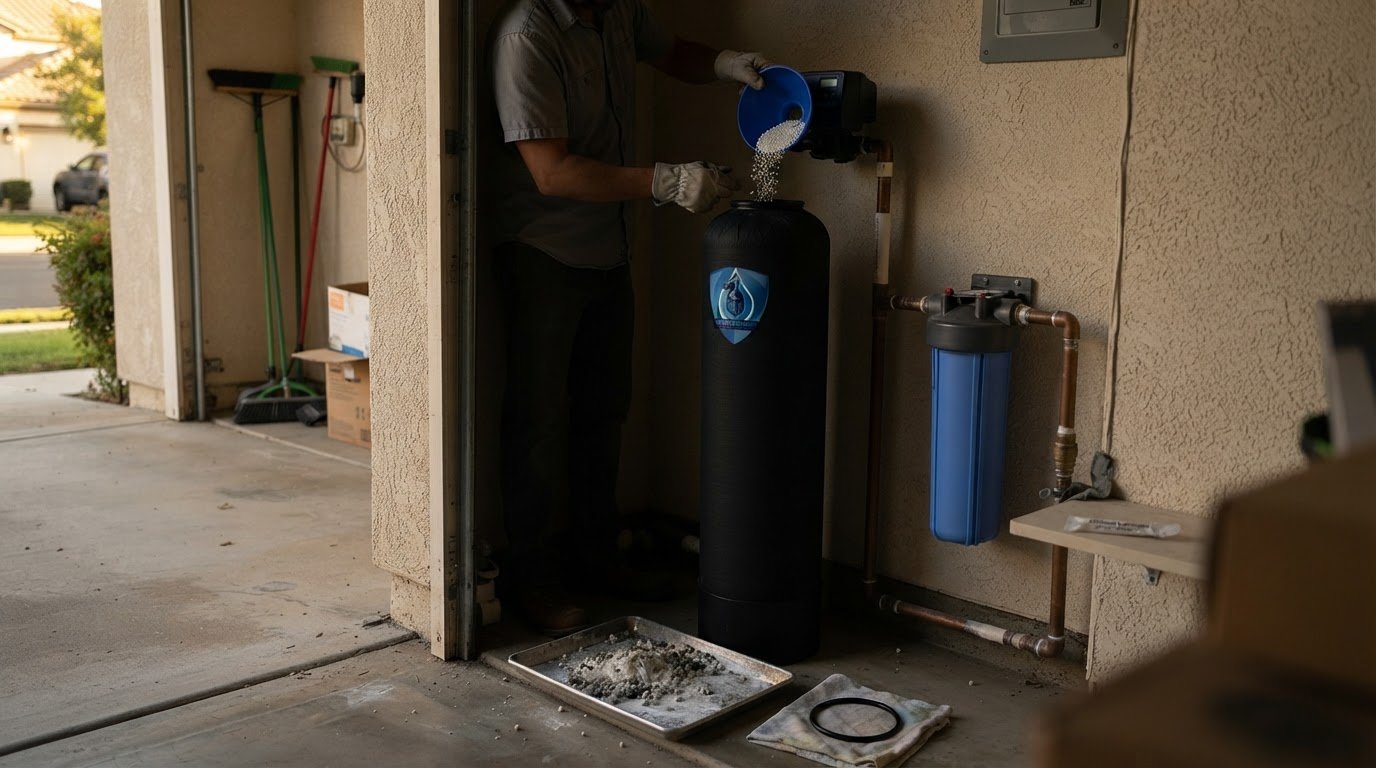
On many whole-house systems, the sediment cartridge is installed inside a removable filter housing—often the familiar blue housing you see mounted near the main treatment equipment. Inside that housing is a replaceable or reusable filter cartridge.
Water contaminants can fall into many different categories. There are chemicals, volatile organic compounds (VOCs), dissolved minerals, microorganisms, and other substances that may require specialized treatment.
Sediment filtration addresses a different category: physical particles in the water.
Depending on whether your home uses municipal water or a private well, these particles can include:
Some particles are easy to see. Others are so small that water can appear perfectly clear even though particulate matter is present.
Sediment filter cartridges are commonly rated according to the size of the particles they are designed to capture. This measurement is expressed in microns.
One micron is one-millionth of a meter.
To put that into perspective, a typical human hair is approximately 50–100 microns in diameter. A 5-micron particle is therefore roughly 10–20 times smaller than the width of a human hair.
That’s small!
A 5-micron sediment filter is commonly used in residential whole-house water treatment because it provides fine particulate filtration while generally maintaining practical flow rates for household use.
However, sediment cartridges are available in many different micron ratings, including 50, 20, 10, 5, 1 micron and even sub-micron filtration.
Smaller isn’t automatically better. The correct micron rating depends on the water conditions, flow requirements, filter design, and what the system is intended to accomplish.
Homes with significant sediment can benefit from staged filtration.
Instead of sending heavily sediment-laden water directly through a fine 5-micron cartridge, a system might first use a larger-pore filter to capture bigger particles and then use a finer filter downstream.
For example:
20 micron → 5 micron
The 20-micron filter captures larger sand, rust, scale and debris. The 5-micron filter then handles the finer particles that pass through the first stage.
This approach can help prevent the finer filter from becoming clogged too quickly and can extend cartridge life.
Water with unusually high levels of sand or sediment may require additional pretreatment or specialized equipment rather than simply installing increasingly fine disposable cartridges.
This is one of the questions we hear most often.
Municipal water goes through extensive treatment before it reaches your home, but it also has to travel through miles of water mains and distribution piping to get there.
Along the way, particulate material can be introduced or disturbed by aging infrastructure, corrosion, mineral scale, water-main repairs, construction, hydrant flushing, and changes in pressure and flow.
Your water can still look crystal clear. That’s because many of these particles are simply too small to be easily seen individually with the naked eye.
Now consider the volume of water moving through your home. Over six months, a family can send tens of thousands of gallons of water through its whole-house treatment system. Even a very small concentration of particulate matter can accumulate when you’re filtering that much water.
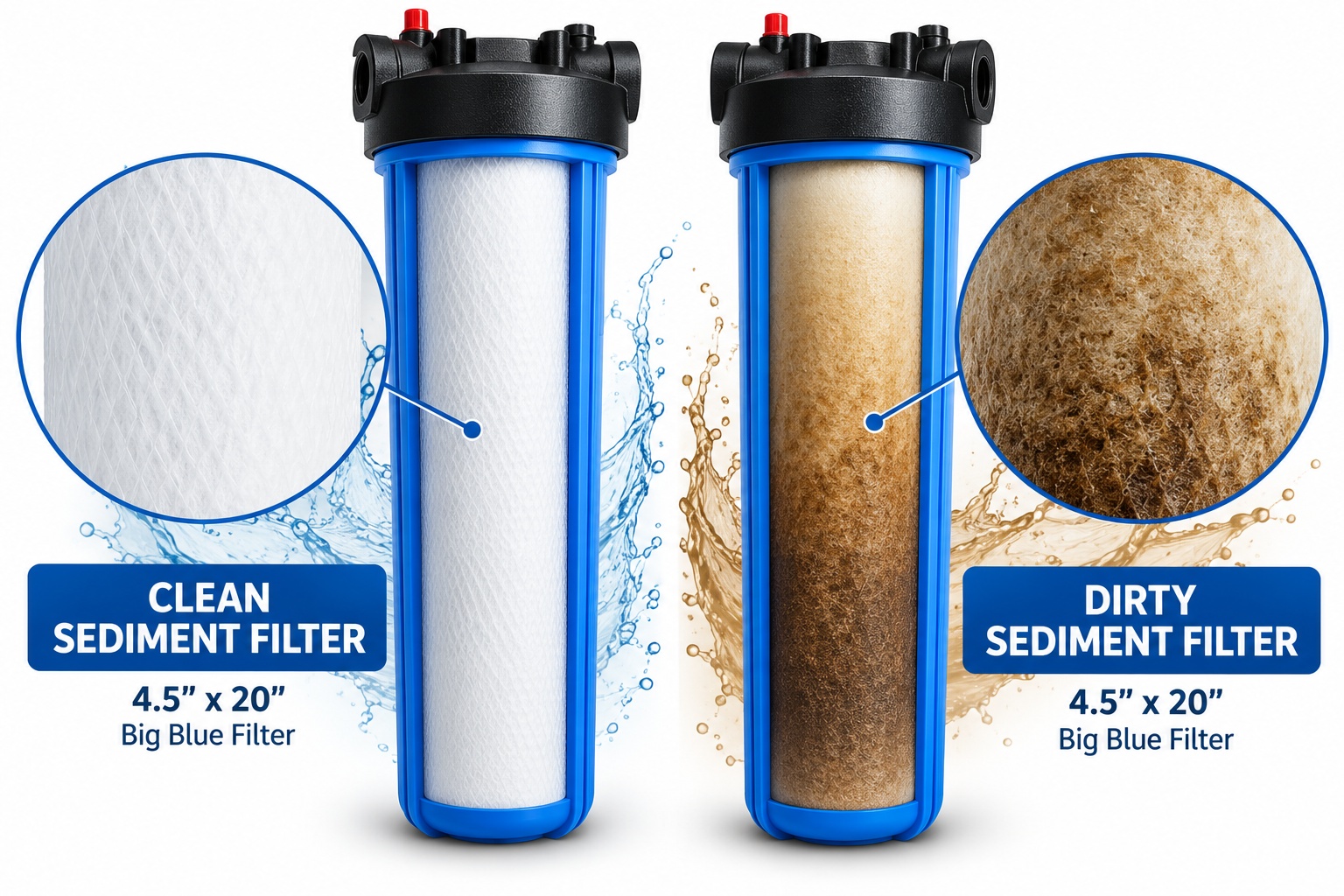
That’s why homeowners are often surprised when they remove a sediment cartridge that started out bright white and discover that it has become brown, orange, gray or nearly black. All of that material was captured before it traveled farther into the home’s water system.
One of the most important purposes of sediment filtration is actually protecting the equipment downstream. Sediment can accumulate in plumbing fixtures, faucet aerators, valves and appliances. It can also interfere with other components of a whole-house treatment system.
Installing sediment filtration before carbon filtration, water softening, UV purification or other treatment equipment can help reduce the particulate load reaching those components. This is particularly important with carbon filtration. You want the carbon media doing the job it was designed to do—not becoming unnecessarily loaded with dirt, rust and other suspended debris.
There isn’t one replacement schedule that works for every home. For many residential applications, sediment cartridges may be replaced approximately every 6–12 months, but actual filter life depends on several factors:
Sediment concentration: Water containing more particulate matter will load a cartridge faster.
Water usage: A household using more water will generally move more particulate matter through the filter.
Micron rating: Finer filters can capture smaller particles but may also become restricted more quickly when sediment levels are high.
Filter size and design: Larger cartridges and different filter materials can have significantly different dirt-holding capacities.
A noticeable reduction in water pressure or flow can be an indication that a sediment cartridge has become loaded and needs to be replaced. Fortunately, replacing a typical whole-house sediment cartridge is a relatively simple maintenance task that many homeowners can perform themselves.
It’s easy to assume:
“My water looks clear, so there can’t be much sediment in it.”
But appearance only tells part of the story.
Sediment filtration isn’t necessarily about removing particles you can see floating in a glass. It’s about continuously capturing very small suspended particles as thousands of gallons of water enter your home.
After months of filtration, seeing the difference between a new sediment cartridge and the one being replaced can be eye-opening.
Whether your water comes from a municipal water system or a private well, sediment filtration is a simple and valuable component of a properly designed whole-house water treatment system.
It’s inexpensive, easy to maintain, and—most importantly—it helps protect the rest of your water treatment equipment and your home’s plumbing.
Have questions about sediment filtration, micron ratings, or choosing the right filtration setup for your water?
CastleGuard Water Systems is happy to help you understand your water and determine which treatment technologies make sense for your home.
Enter your email address to instantly reveal your discount code for orders over $750.
Search by product name, model number, SKU, or category.