
An ultraviolet water filter system can inactivate susceptible microorganisms, but it isn’t a catch-all filter. UV light doesn’t remove sediment, chemicals, metals, or hardness. Knowing that distinction helps you identify what a UV unit can address and what may need a separate treatment method.
Whether UV is a suitable fit depends on your water conditions and whether the water is clear enough for UV light to reach microorganisms effectively. This guide explains what UV treatment can and can’t do, and what to check before choosing a system: water testing, pretreatment needs, flow capacity, product documentation, and maintenance requirements. Use these criteria to compare options based on your household’s water, rather than expecting one device to address every concern.
If you’re considering ways to support your household’s water safety, start by understanding what UV treatment is designed to do. An ultraviolet water filter system exposes flowing water to ultraviolet light to inactivate susceptible microorganisms. It can be one part of a home treatment plan, but it won’t address every kind of water concern.
UV disinfection inactivates certain microorganisms; filtration physically captures particles, and neither should be assumed to remove every dissolved contaminant. Your water source, test results, and specific concerns can help determine whether UV is worth considering. Match treatment to the conditions you’ve identified instead of assuming there’s a problem or that one system will solve everything.
Water flows through a treatment chamber and past a UV lamp. The light can damage the genetic material of susceptible microorganisms, preventing them from functioning or reproducing. This process, known as Ultraviolet germicidal irradiation (UVGI), disinfects rather than physically removing organisms. Inactivated organisms may remain in the water. Performance depends on the particular system and incoming water conditions, so check the model documentation instead of assuming all units work the same way.
UV treatment doesn’t remove sediment, minerals, or dissolved chemical contaminants. It won’t soften hard water or capture particles that make water cloudy. Those concerns may require a separate filtration or treatment method selected for the contaminant identified in a water test. Water clarity matters, too, because particles or cloudiness can interfere with UV exposure. If your water needs additional treatment, UV may be one stage in a broader setup rather than a stand-alone solution.
Inside a UV unit, water passes through a chamber where a lamp exposes it to ultraviolet light. The treatment is designed to disrupt susceptible microorganisms’ ability to function or reproduce; it doesn’t strain them out of the water. An ultraviolet water filter system works as intended only when its design and operating conditions provide the exposure specified by the manufacturer.
UV treatment exposes flowing water to ultraviolet light to inactivate susceptible microorganisms, but it doesn’t add a disinfectant residual that continues protecting water downstream. In a home, treatment happens in the UV chamber. Water farther along the plumbing receives no ongoing UV exposure. The CDC’s overview of home water treatment systems can help you compare UV with other treatment approaches.
Cloudiness and suspended particles can block or scatter UV light, shielding microorganisms from exposure. That’s why water quality matters when selecting a unit. A water test may identify concerns that call for pretreatment, such as sediment filtration. Check the system documentation for required incoming water conditions rather than assuming the same setup suits every home.
No single performance claim should be assumed to apply to every organism or installation. Effectiveness depends on the microorganism, UV dose, equipment design, water flow, and operating conditions. For example, faster flow may reduce exposure time if the system isn’t sized for that demand. Check model-specific documentation for performance and operating limits, and maintain the unit as directed. If you’re comparing options, CastleGuard offers ultraviolet system options. Confirm compatibility and maintenance details before choosing.
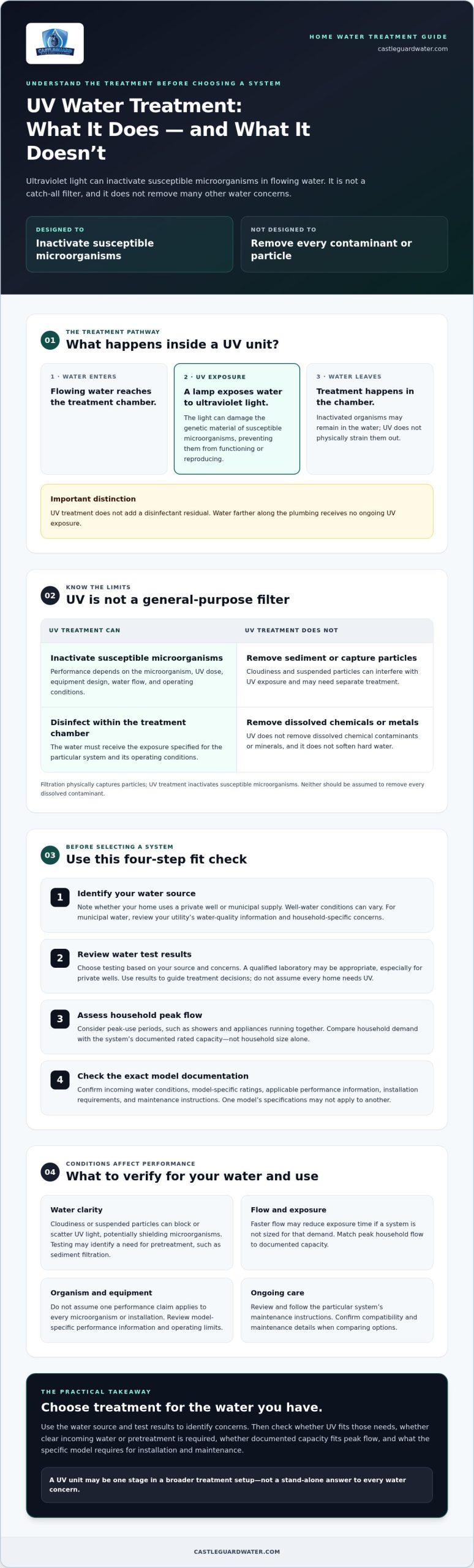
Choose based on your water and household needs, not a product label. Use this four-step check before selecting an ultraviolet water filter system:
Start with the questions raised by your water source and household concerns. For a private well, review available test results and identify whether the water conditions could affect UV performance or require pretreatment. For municipal water, consult utility information and investigate specific concerns with suitable testing. Testing helps guide a treatment plan; it isn’t a blanket recommendation to install UV.
Peak household flow must be compatible with the manufacturer’s rated capacity. A unit that can’t accommodate demand may not provide the performance described for its operating conditions. Check the current documentation for capacity, water-quality requirements, and installation details, then confirm the model suits your home’s setup.
Use this checklist: identify your source, review test results, match peak flow to documented capacity, and verify the model’s requirements. Explore CastleGuard’s ultraviolet system options, and confirm compatibility and maintenance details before choosing.
Use your water test and household needs to compare treatment approaches, then check each option against current manufacturer documentation. The right ultraviolet water filter system should suit both the water entering it and your home’s flow needs. If you’re deciding between UV and chlorine-based methods, reviewing how a UV sterilizer compares to chemical water treatment can help you understand which approach fits your water conditions and concerns.
| Approach | May suit | Check before choosing |
|---|---|---|
| UV-only treatment | Water that meets the unit’s required conditions and needs UV disinfection. | Rated capacity, incoming water requirements, and performance documentation. |
| UV with pretreatment | Water that needs conditioning or filtration before UV exposure. | Which pretreatment suits the test results and whether the combined setup meets flow needs. |
| Broader multi-stage treatment | Homes with several identified water concerns requiring different treatment methods. | What each stage treats, how components work together, and the care required for the full system. |
For any approach, compare documented capacity, required water conditions, performance information, and ongoing care needs. Don’t assume a UV unit addresses concerns outside its intended purpose.
Maintenance intervals and replacement parts vary by model. Before purchasing, find out what inspections, cleaning, and component replacements the manufacturer requires, and how to obtain the correct parts. Follow the written instructions rather than applying a schedule from another unit. Keep service records of maintenance dates and replaced components to track care over time.
If test results raise questions or you’re unsure whether a model suits your water conditions and flow needs, contact CastleGuard’s customer support, available Monday through Friday. CastleGuard offers UV systems; confirm the specifications and maintenance details for the option you’re considering. Homeowners with private wells can also consult the guide How to Use UV Light for Well Water Disinfection in 2026 as they review their treatment needs.
A UV system can be a useful part of home water treatment when it suits the microorganisms of concern and the conditions of your water. UV inactivates susceptible microbes, but it doesn’t remove sediment, minerals, or dissolved chemicals. Water testing, suitable pretreatment, and a system sized for household flow can help you make a more informed choice.
Before selecting an ultraviolet water filter system, review its documented capacity, water-quality requirements, and maintenance instructions. CastleGuard offers ultraviolet systems, and its customer support team is available Monday through Friday to answer questions about options and model compatibility.
Explore CastleGuard’s ultraviolet water system options and take the next step with a clearer understanding of what your home needs. If you live in Southern California, Nevada, Arizona, Texas, or Florida, start by reviewing your water source and available test information, then compare systems against your household’s needs.
An ultraviolet water filter system exposes flowing water to UV light to inactivate susceptible microorganisms. Despite its common name, it doesn’t physically filter particles or remove dissolved chemicals. Whether it’s appropriate for your home depends on water quality, household flow needs, the system’s documented specifications, and maintenance requirements. Review those factors first so UV is considered for the right purpose, not as a solution for every water concern.
UV systems are designed to inactivate susceptible microorganisms, but performance can vary by organism, equipment, and operating conditions. Don’t assume every unit treats every pathogen equally. Check reliable product documentation for verified performance, and consult relevant water-testing guidance if you’re addressing a specific concern. For a private well, use test results to guide treatment choices rather than relying on a UV unit alone.
No. Ultraviolet treatment targets susceptible microorganisms; it doesn’t remove sediment or dissolved contaminants such as chlorine or lead. If your concern is sediment, for example, you may need a suitable filtration method. For dissolved contaminants, identify the issue through appropriate water-quality information or testing, then choose treatment designed for that concern. UV may be one part of a treatment setup, but it isn’t a catch-all filter.
A UV system may be considered for well water when test results and treatment needs support that choice. Water clarity, flow, system sizing, and manufacturer requirements all matter, and other identified contaminants may require separate treatment. Homeowners with private wells in Southern California, Nevada, Arizona, Texas, and Florida should review their well-water test results and consult qualified guidance. Don’t assume a UV unit by itself makes well water safe.
Maintenance schedules vary by model, so follow the current manufacturer instructions instead of relying on a generic interval. Before buying, ask what inspections, cleaning, replacement parts, and other service the selected system requires. Confirm that compatible components are available for that model, and keep a record of completed maintenance. These steps help you plan ongoing care and understand what’s needed to keep the unit operating as specified.