Could a whole home UV light water filter protect your household while leaving important water concerns untouched? UV treatment can inactivate susceptible microorganisms, but it doesn’t remove sediment, metals, chlorine, or other chemical contaminants. If you’re comparing systems, start by identifying what you want to treat and checking whether the equipment is designed for that purpose. The right choice depends on your water and the system’s documented requirements.
This checklist will help you assess whether UV treatment fits your needs, compare system requirements, and plan maintenance. Use it to check flow capacity, pretreatment needs, installation requirements, certification claims, and care instructions for the lamp, sleeve, and system alerts. Homeowners in Southern California, Nevada, Arizona, Texas, and Florida should assess their own water and household demand rather than assume one setup suits every location.
A whole home uv light water filter treats water as it passes through a UV unit installed in household plumbing. UV exposure is designed to inactivate susceptible microorganisms by interfering with their ability to reproduce. This process is called disinfection, not filtration: it doesn’t physically remove particles or dissolved contaminants. For a science overview, see Ultraviolet germicidal irradiation (UVGI).
That distinction matters when choosing equipment. UV treatment doesn’t address chemical contaminants, metals, chlorine, sediment, or taste concerns. A UV unit may be one stage in a treatment setup, but it can’t replace water testing or treatment selected for a specific issue.
Start with the concern, then choose an appropriate water test instead of assuming UV is the answer. Your water source and test results can help identify whether the priority is microbial, chemical, taste-related, or something else. Use those findings to determine which treatment stages may be appropriate and what each stage needs to address.
Particles or cloudy water can interfere with UV exposure by shielding microorganisms, so pretreatment may be necessary. Requirements vary by system. Check the product documentation for water-quality and pretreatment instructions rather than relying on a general rule. Clear-looking water alone doesn’t confirm that UV is suitable or that other concerns have been addressed.
Think of UV as a treatment with a specific role, not an all-purpose solution. Testing can help you understand whether it belongs in your setup and whether additional treatment is needed for the concerns identified.
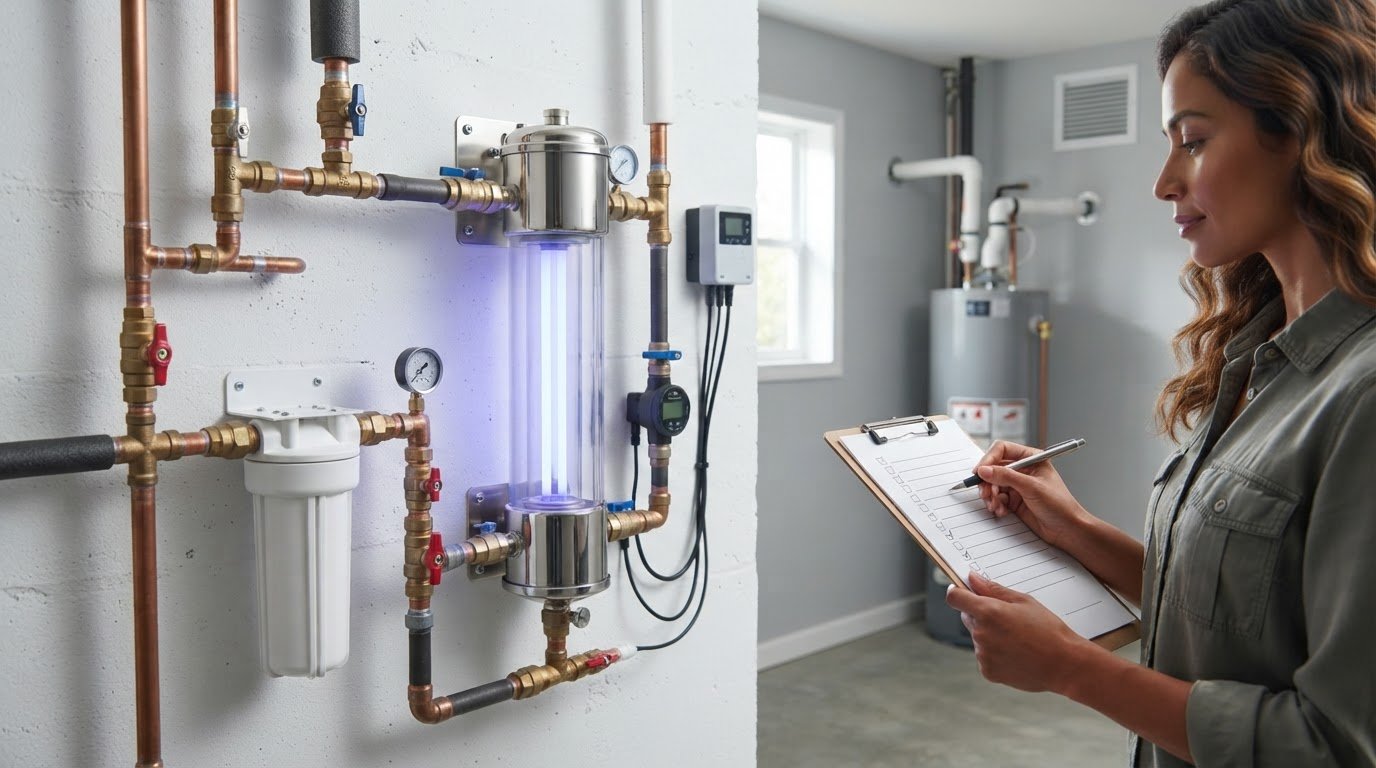
In a whole-home setup, water enters a treatment chamber, passes by a UV light source, and continues through the household plumbing. The exposure is intended to inactivate susceptible microorganisms. Unlike chemical disinfection, UV treatment leaves no disinfectant residual in the water, so it doesn’t provide ongoing disinfection farther along the plumbing if contamination enters downstream.
Suitability depends on several connected factors: household peak flow, the system’s rated capacity and operating conditions, water clarity and other quality requirements, any required pretreatment, and correct installation position. The CDC’s home water treatment guidance also emphasizes considering the specific contaminants a treatment system is intended to address.
Compare each candidate’s documented flow capacity with your household’s needs, including periods when several taps may run at once. Check the required water-quality conditions, where the unit belongs in the plumbing sequence, and whether pretreatment or specific operating conditions are required. Don’t assume that systems with similar appearances have the same specifications.
NSF/ANSI 55 distinguishes between UV systems intended for microbiologically unsafe water and systems for supplemental treatment of already disinfected water. If a seller or product listing claims certification, verify the exact model and classification in the current certification directory. A general reference to the standard doesn’t establish that a specific unit is certified.
CastleGuard Water Systems (CastleGuard) offers ultraviolet systems. Confirm model-specific flow, certification, and operating details before choosing. Once you’ve identified your water needs, you can review CastleGuard’s ultraviolet systems and ask support about the documentation for the model you’re considering.
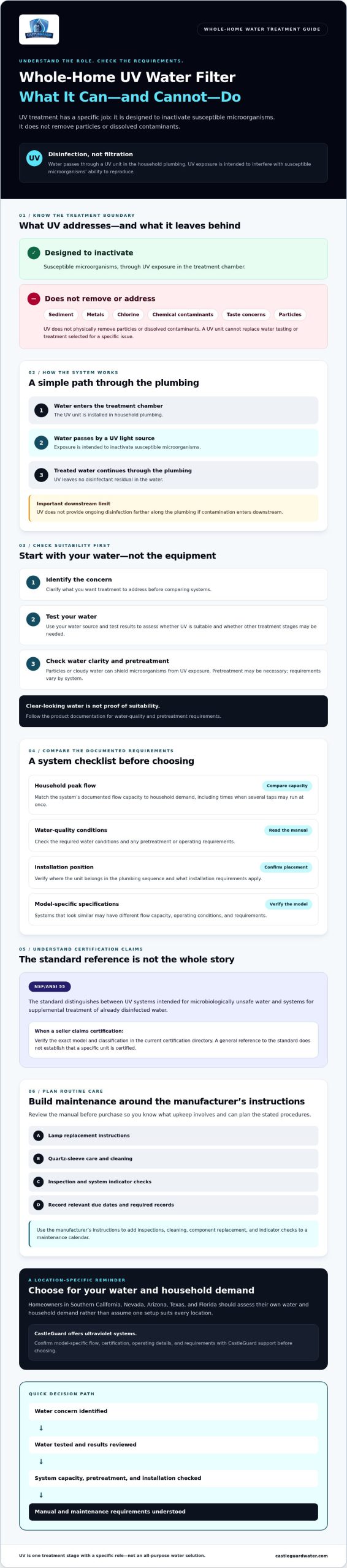
A practical routine starts before purchase: match the system to your water needs, then use its manual to plan upkeep. Work through these steps for a whole home uv light water filter:
Use the manufacturer’s instructions to add each inspection, cleaning, component replacement, and indicator check to a calendar. Record the relevant due dates, then follow the unit’s instructions if an alert appears or operation changes. A lamp can still light while no longer meeting its intended replacement timing, so appearance alone isn’t a reliable way to judge it.
Follow the selected system manufacturer’s instructions for replacement timing. Don’t apply a generic schedule to a model with different requirements.
Don’t choose by advertised capacity alone. Compare the documented capacity with household demand and source-water conditions, then confirm installation and maintenance details for the exact model. Use the owner’s manual for model-specific care, including any stated steps for inspection, cleaning, and component replacement.
CastleGuard offers ultraviolet systems. Review CastleGuard’s ultraviolet systems and confirm model-specific requirements with support before choosing.
A confident choice comes from matching the system to your water needs, not relying on a general product description. Before selecting a whole home uv light water filter, bring together your water concern and test results, expected household demand, documented system capacity, operating and pretreatment requirements, and the maintenance tasks you’re prepared to manage.
Ask which documented model requirements fit your water conditions and expected flow. Request the current manual and any available certification documentation for the exact model. Check the installation position, required pretreatment, routine inspections, cleaning steps, and replacement components. Knowing these details in advance helps you assess the full care routine as well as the equipment’s fit.
CastleGuard offers ultraviolet systems, but verify specific models, specifications, and included components rather than assuming them. Its support line is available Monday through Friday. Contact support during those hours to ask about current model documentation and whether the stated requirements align with your test results and household demand.
If your water test identifies a concern UV isn’t designed to address, compare treatment approaches suited to that result before purchasing. A chemical or taste concern, for example, calls for a different selection question than a microbial concern. A comparison of UV sterilization and chemical water treatment can help clarify how their purposes differ. Use your test results and system documentation to guide your decision.
Take time to confirm the details. Understanding performance claims, system requirements, and ongoing care can help you choose a treatment approach that fits your home and maintain it responsibly.
Explore CastleGuard water systems to review the available options.
A dependable whole home uv light water filter is one part of a treatment plan, not simply a lamp in the plumbing. UV targets susceptible microorganisms, but it doesn’t address every water concern. Testing helps identify what needs treatment and whether UV, another treatment stage, or a combination is appropriate.
Before choosing, compare your household’s water needs with the exact system’s documented capacity, operating conditions, and pretreatment requirements. Check the manual for maintenance tasks and component replacement instructions, then add them to a calendar. Following model-specific guidance makes ongoing care easier to track and helps you avoid guesswork.
CastleGuard offers ultraviolet systems, and customer support is available Monday through Friday. After reviewing your water test and selection criteria, ask support about current model documentation. Explore CastleGuard water systems to review the available options and choose a system that fits your needs.
No. UV treatment is intended to inactivate susceptible microorganisms, not remove dissolved chemicals, metals, salts, or compounds that affect taste. If those are concerns, arrange appropriate water testing and compare treatment options designed for the identified issue. A UV unit may be one stage in a broader setup, so check the exact system documentation to understand its role and any additional treatment requirements.
Replace the lamp according to the specific system manufacturer’s instructions. Check the manual for its stated lamp life, inspection guidance, and indicator requirements, then record the schedule so it’s easy to follow. Don’t apply a generic interval to every unit. A lamp that still lights may not be operating as intended, so appearance alone isn’t a reliable way to judge when replacement is due.
It may, depending on your source water and the exact system’s requirements. Particles or cloudy water can interfere with UV exposure, so review the manufacturer’s water-quality specifications and consider testing before installation. Follow the product documentation to determine whether pretreatment is needed. Whether your home is in Southern California, Nevada, Arizona, Texas, or Florida, don’t assume the same setup suits every water supply.
A UV system may be considered for either source, but suitability depends on water test results, household flow needs, water quality, and the unit’s documented requirements. Well and municipal supplies can raise different treatment considerations, so assess your own water rather than assuming one configuration fits every home. Check the exact system instructions before choosing a whole home uv light water filter.
Start by identifying your water concern and confirming it with appropriate testing. Then compare the system’s flow requirements, source-water specifications, pretreatment needs, installation requirements, and maintenance instructions. If certification is claimed, verify it for the exact model. Ask how the lamp and other components are monitored or replaced, and use the manual to confirm the upkeep routine before deciding whether the system fits your home.