What if you could reduce scale buildup without removing the minerals that make water hard? That’s the idea behind salt free scale prevention, which may appeal if you want to address deposits without a salt-based softener. A conditioner does not necessarily make hard water soft: calcium and magnesium can remain in the water, so the feel and soap response may not change.
Before choosing a system, get clear on what you want it to do. Are you trying to address deposits on a faucet, inside a kettle, or on an appliance? Do you also want to reduce hardness minerals? The right fit depends on your water conditions and the specific system, so compare your test results with current product documentation.
This guide explains how salt-free conditioning works, where its limits matter, and how it differs from water softening. You’ll learn what information to gather, which questions to ask, and how to set realistic expectations for fixtures and appliances.
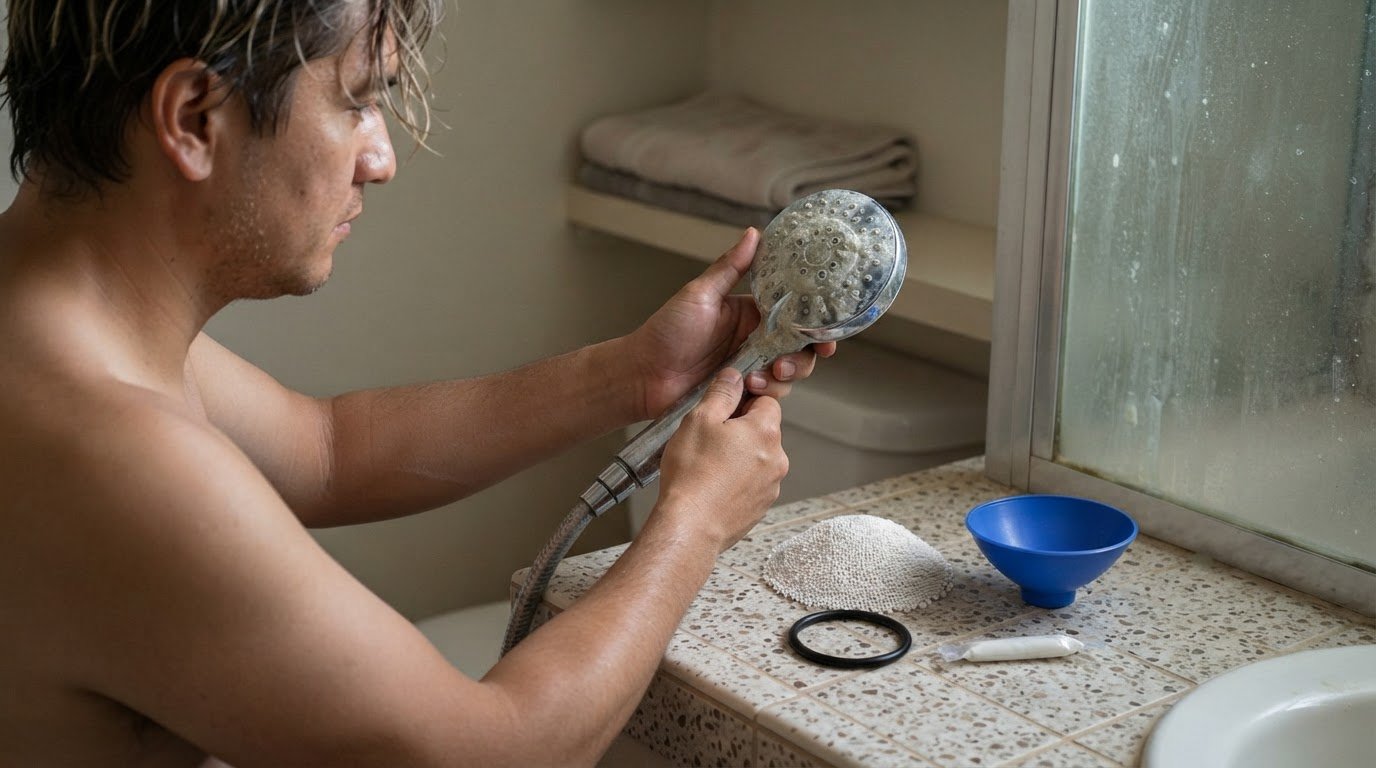
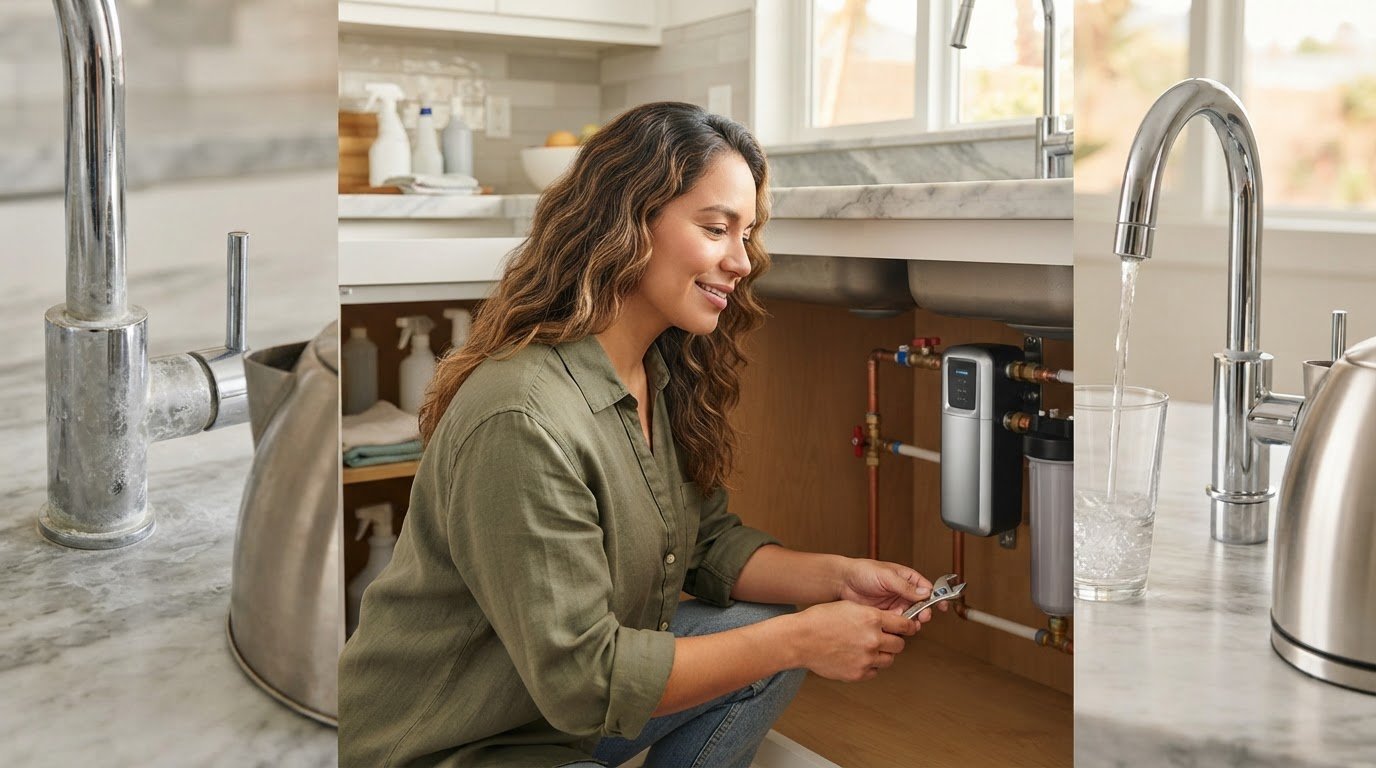
Hard water contains dissolved minerals, especially calcium and magnesium. Scale is the solid residue that can form when conditions cause those minerals to deposit on surfaces. You may see a chalky ring around a faucet or residue inside a kettle. Deposits can also collect in plumbing and on heated surfaces, though the amount and location depend on the water conditions in your home.
Salt free scale prevention aims to reduce mineral deposits without necessarily removing hardness minerals from water. Dissolved minerals and the visible scale they may form are related, but they are not the same thing. Salt-free approaches are generally described as water conditioning, distinct from traditional softening methods that remove or exchange hardness minerals. The process depends on the specific system.
When water heats, evaporates, or undergoes changes in its chemistry, dissolved minerals may come out of solution and settle on nearby surfaces. A kettle may develop residue where water is repeatedly heated, while a faucet can show deposits as droplets dry. These examples can help you identify where scale appears, but one household’s experience does not predict another’s. Water conditions and the surfaces involved both matter.
Hardness and broader water chemistry can vary by source, location, and household plumbing. A city water report can be a useful starting point; well owners may need a test suited to their supply. If you live in Southern California, Nevada, Arizona, Texas, or Florida, look for information that applies to your own supply rather than relying on a general regional assumption. Compare the results with the system’s documented operating conditions before deciding whether it may fit.
Salt-free conditioners are designed to affect how hardness minerals behave, with the aim of making them less likely to form deposits. The goal is to manage scale formation, not necessarily to change how much calcium or magnesium is dissolved in the water. Technologies and results vary, so do not assume every system works the same way or provides identical protection.
Scale prevention addresses the tendency to form deposits; softening changes the water’s hardness-mineral content. In ion-exchange softening, a resin exchanges calcium and magnesium ions for other ions, commonly sodium. Salt-free conditioning is not automatically equivalent. Do not assume conditioned water is soft or mineral-free unless the product documentation supports that claim.
Not by default. Unless the manufacturer’s documentation confirms mineral removal, assume calcium and magnesium remain present. A system may aim to change scale behavior while the water still tests hard and retains its mineral content. When comparing options, decide whether your priority is fewer deposits, reduced hardness, or both. Those goals may call for different treatment approaches.
Check the current documentation for the system’s specific technology, suitable water conditions, limitations, and care requirements. A media type, capacity, or lifespan stated for one product is not a category-wide standard. Ask what a performance claim measures, which conditions it applies to, and whether those conditions match your water test.
For homeowners considering salt free scale prevention, CastleGuard lists Salt-Free Conditioner Kits among its offerings. Check the kit’s current specifications and suitability for your water before deciding. Do not infer its mechanism or performance from the product category alone. Reviewing salt-free conditioner options can be one step in your comparison.
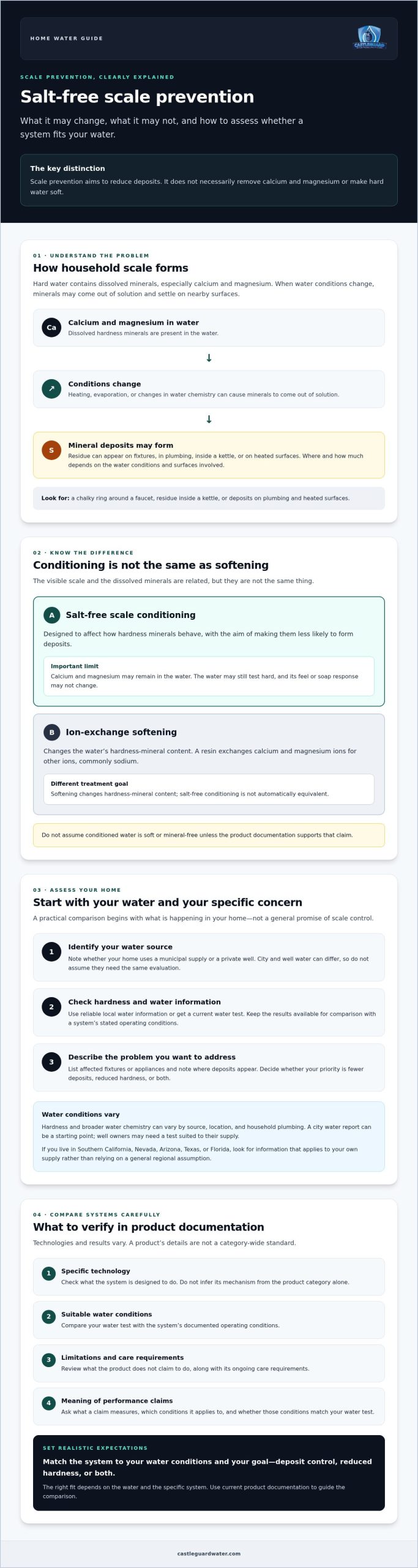
A practical comparison starts with your water and the problem you want to address, not a general promise of scale control. Use these steps before choosing salt free scale prevention:
Gather your water information and a clear description of the scale issue first. For a wider explanation of how salt-free systems are presented, see this eco-friendly water softener alternatives guide. Use it alongside current product documentation, which should identify the specific system’s technology and suitable conditions.
CastleGuard lists Salt-Free Conditioner Kits among its offerings. If you are comparing options, review CastleGuard’s salt-free conditioner options and compare the documented product fit with your water conditions before deciding.
A suitable system should match your tested water and household goals, not just a general promise of scale control. When comparing salt free scale prevention options, look at the product’s confirmed technology, compatible water conditions, documented limits, and ongoing care requirements. Keep the treatment goal in view: conditioning may target scale formation, but it is not the same as removing hardness minerals.
Use the current product documentation to get specific answers before deciding:
Look for product-specific information rather than assuming a claim applies to every salt-free conditioner. If a detail is unclear or missing, ask for the current documentation instead of relying on a broad category description.
If your main goal is to reduce calcium and magnesium in the water, compare treatment methods designed to address hardness minerals. A salt-free conditioner may not meet that goal. Use your test results and household requirements to guide the comparison. Scale concerns alone do not confirm that a particular treatment approach is a fit.
CastleGuard lists Salt-Free Conditioner Kits for homeowners researching conditioning. Confirm the product’s specific technology and operating conditions before choosing, and consider how they relate to your water results. For product information, contact CastleGuard to confirm Salt-Free Conditioner Kit details.
The right approach starts with your home’s water, not a broad promise. Salt free scale prevention is intended to address scale formation, but it should not be mistaken for removing hardness minerals or making water soft. Test your water, identify the household concerns you want to address, and compare each system’s documented compatibility, limits, and care requirements.
CastleGuard lists Salt-Free Conditioner Kits among its whole-home water protection offerings. Since product specifications and suitable conditions matter, check the current details before deciding whether a kit fits your home. CastleGuard customer support is available Monday through Friday if you have questions about its offerings.
Explore CastleGuard water conditioning options and compare the product information with your water results before choosing.
Generally, no. Salt-free scale prevention is intended to reduce how readily scale forms, not remove dissolved calcium and magnesium. Conditioned water should not automatically be described as softened or mineral-free. If mineral removal is your goal, test your water and check the specific system’s current documentation for its technology and limitations. That distinction helps you compare options based on what you want the water treatment to do.
A salt-free conditioner may be designed to help manage scale formation, but the result depends on the system, your water, and the product’s documented operating limits. Do not assume every conditioner offers the same results. Check whether product claims address your specific concern, such as deposits on a water heater or another appliance, and compare those claims with your household water information before relying on them.
Salt-free systems use conditioning approaches intended to influence scale formation rather than remove hardness minerals through salt-based ion exchange. The mechanism varies by product, so one manufacturer’s explanation or performance claim should not be applied to every system. Review current documentation for the specific technology, compatible water conditions, maintenance requirements, and limitations. This gives you a clearer basis for judging whether a system fits your home.
No. These approaches have different treatment goals. Salt-free conditioning is generally intended to manage scale formation, while conventional ion-exchange softening reduces hardness by exchanging calcium and magnesium ions. Do not expect a salt-free conditioner to remove hardness unless its product documentation specifically confirms that capability. Start with a water test, then decide whether you want to address scale behavior, reduce mineral content, or evaluate both goals.
It depends on your water chemistry, household needs, and the system’s documented operating conditions. Identify whether your home uses city or well water, then obtain reliable hardness information or a water test. Homeowners in Southern California, Nevada, Arizona, Texas, and Florida should use information specific to their own supply. CastleGuard lists Salt-Free Conditioner Kits, but check current product compatibility before choosing.