Can a system run without electricity and still leave hardness minerals in your water? The phrase “non electric water conditioner” can sound like a straightforward alternative to a water softener, but the two may treat water differently. The key is to separate how a system operates from what it does to your water.
This guide explains common non-electric approaches, including salt-free conditioners designed to help manage scale and mechanical softeners that can use water pressure to operate. You’ll learn how conditioning differs from softening and filtration, what to look for in product information, and how to compare maintenance needs. For homeowners exploring salt-free conditioning, CastleGuard Water Systems offers salt-free conditioner kits. Understanding your water and your treatment goal can help you decide what to consider next.
A non-electric water conditioner is a water-treatment system designed to operate without electrical power. The term describes how a system runs, not what it changes in your water. Some systems use water flow or pressure to operate; others work passively. The treatment result depends on the specific mechanism, so “non-electric” alone doesn’t tell you whether a system softens, filters, or manages scale.
That depends on the system and the water measurements. Some conditioning approaches aim to change how calcium and magnesium behave so they’re less likely to form scale, while leaving those minerals in the water. A system that removes hardness minerals works differently. Check the product’s stated function and performance information rather than assuming every conditioner produces the same result.
Ion exchange is a common softening method. It reduces calcium and magnesium in water by exchanging hardness ions for other ions. Not every non-electric system uses ion exchange. The Water softening overview explains this foundational approach. For more on salt-free approaches, see our salt-free water conditioner guide.
| System type | Typical treatment goal | What to verify |
|---|---|---|
| Conditioner | May help manage scale behavior | Whether hardness minerals remain |
| Softener | Reduces hardness minerals, often through ion exchange | How hardness is reduced and measured |
These are broad distinctions, not guarantees for every system. A salt-free conditioner kit, such as those offered by CastleGuard, is a different treatment category from a conventional ion-exchange softener. Compare each system’s stated function and documented results with your own goal.
There isn’t one mechanism behind every non-electric water conditioner. Some systems use water flow or pressure to operate a mechanical control; others condition water without an electrical control system. Product documentation should explain which approach applies. Treatment performance depends on the system’s mechanism and your water conditions.
A water-powered design may use flowing water to move a meter or trigger a mechanical process. That applies only to systems designed for that operation, not to every non-electric conditioner. “No electricity” also doesn’t mean “no maintenance.” Follow the product’s instructions for care, such as checking components or replacing treatment media if specified. The University of Minnesota’s overview of water softener alternatives provides context on non-salt-based options.
Keep three treatment goals separate. Scale management aims to limit deposits on surfaces or equipment. Hardness removal reduces dissolved calcium and magnesium. Filtration targets particular particles or contaminants. A scale-control claim doesn’t prove that hardness minerals are removed, and conditioning alone isn’t evidence of disinfection or contaminant removal.
Look for information about the specific system and the outcome you care about, rather than relying on broad category claims. Homeowners considering salt-free scale control can also review CastleGuard’s salt-free conditioner kits. Compare the product’s stated function with your water information and priorities.
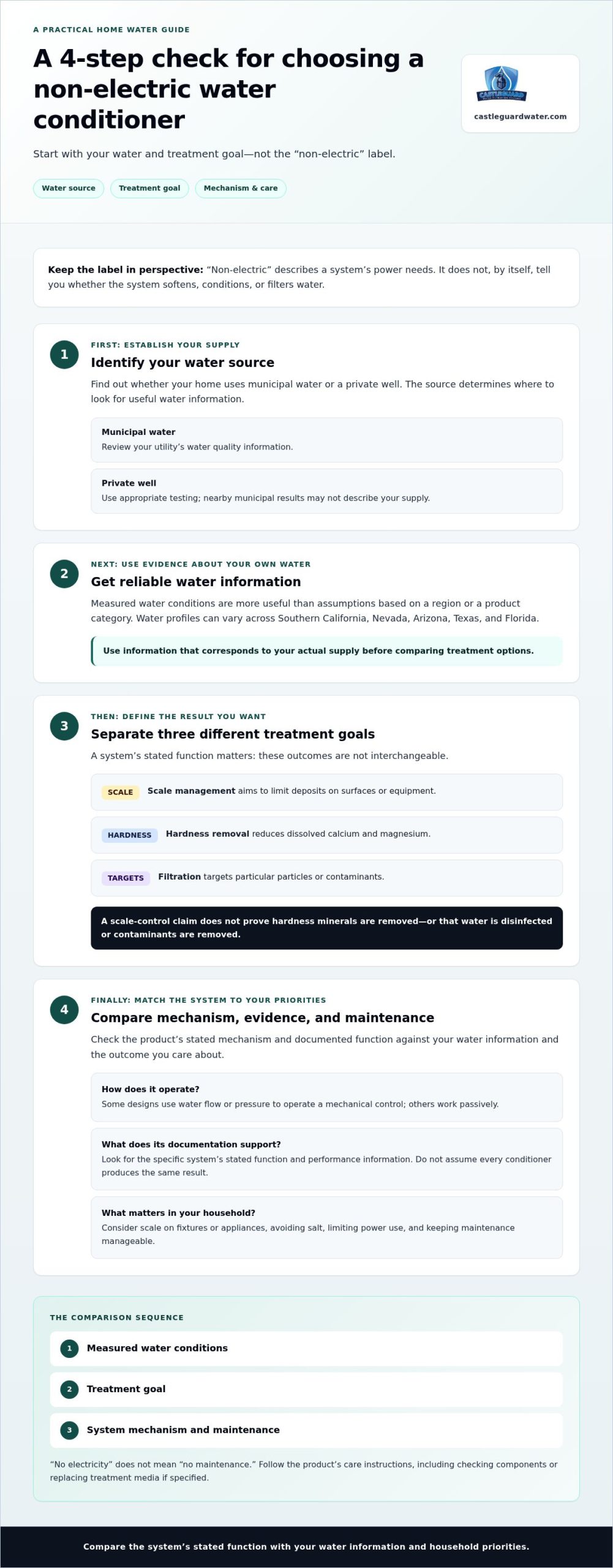
Start with your water, not the system label. A non electric water conditioner may suit your priorities if scale management is the goal, but measured water conditions and the treatment mechanism should guide your decision. Water profiles can vary across Southern California, Nevada, Arizona, Texas, and Florida, so a regional assumption isn’t a substitute for information about your own supply.
Rank what matters most to your household, such as scale on fixtures or appliances, avoiding salt, limiting power use, and keeping maintenance manageable. Then compare those priorities with each system’s stated function and care requirements. Broad promises of “better water” aren’t evidence that a system delivers every outcome. The eco-friendly softener alternatives guide offers more context for weighing approaches.
Use this checklist: measured water conditions first, treatment goal second, system mechanism and maintenance third. CastleGuard offers salt-free conditioner kits for homeowners exploring conditioning. Explore salt-free conditioner kits as you compare options with your household’s needs.
A useful comparison starts with what you want your water treatment to accomplish, not the words “non-electric.” Use this checklist to assess each non electric water conditioner against your water information and household priorities:
Compare like with like. A claim about scale control isn’t the same as a claim that calcium and magnesium are removed. Neither automatically means contaminants are filtered. Look for product-specific information rather than assuming systems in the same category deliver identical outcomes.
Set expectations around the system’s stated treatment goal. If it’s intended to manage scale, don’t assume it will soften water or change every symptom you notice. Follow the product’s maintenance instructions and note any replacement-media guidance provided for that system.
CastleGuard offers salt-free conditioner kits for homeowners considering this category. CastleGuard also provides customer support Monday through Friday and automatic filter deliveries. These are general support and delivery options, not specifications about conditioner kit contents.
Use your water information and priorities to narrow the comparison, then read the documentation for the system you’re considering. Choose based on its stated mechanism, intended result, care requirements, and supporting evidence. Explore CastleGuard water-conditioning options as you consider salt-free conditioning for your home.
The right choice starts with your water, not the label on a system. A non electric water conditioner describes how a system operates, but its mechanism determines whether it manages scale, removes hardness minerals, or performs another treatment function. Use reliable water information to define your goal, then compare documented performance and maintenance needs.
For homeowners considering salt-free conditioning, CastleGuard offers salt-free conditioner kits, along with weekday customer support and automatic filter deliveries. Keep your expectations tied to the specific system’s stated purpose, and use product guidance to plan for ongoing care.
Ready to explore an option for your home? Explore CastleGuard’s salt-free water-conditioning options. Start with your water information and priorities, then compare the options that match them.
Not necessarily. “Non-electric” describes how a system operates, not whether it removes hardness minerals. Some conditioners are intended to help manage scale while leaving calcium and magnesium in the water; a softener typically reduces those minerals, often through ion exchange. Check the system’s stated function and measured results to see whether it matches your goal of scale control or softer water.
A non electric water conditioner works according to its specific treatment mechanism. Some non-electric systems use water flow or pressure to operate mechanical components, while some salt-free conditioners are designed to condition water without electrical controls. These approaches aren’t interchangeable, and the label alone doesn’t explain the result. Review product-specific documentation for the mechanism, intended treatment outcome, operating requirements, and supporting evidence.
Some systems may reduce calcium and magnesium, but a scale-conditioning system shouldn’t be assumed to do so. It may instead aim to change how hardness minerals behave while leaving them dissolved in the water. To understand the result, compare water measurements before and after treatment and check whether the system’s documentation specifically describes hardness reduction. Scale management, mineral removal, and filtration are separate treatment goals.
They may. Operating without electricity doesn’t mean a system is maintenance-free. Care depends on its design and may include checking components or replacing treatment media according to the product’s instructions. Before choosing a system, review its maintenance schedule and replacement-media guidance. This helps you understand the ongoing care involved without assuming every non-electric model needs the same upkeep.
No single treatment approach is right for every household. Start with reliable information about your water, then decide whether your priority is scale management, hardness reduction, or another treatment need. That process matters for homeowners in Southern California, Nevada, Arizona, Texas, and Florida, where location alone shouldn’t be used to assume a home’s water profile. Match the system’s documented function to your measured conditions and priorities.