
What if the best whole home water filter for hard water in Arizona isn’t a filter that removes hardness at all? The U.S. Geological Survey lists Arizona’s median water hardness at 9.8 grains per gallon, classified as hard. That figure is useful context, but water conditions can vary by source and household, so it’s only a starting point for choosing a system.
It’s understandable to want one system to protect fixtures and appliances from scale while improving water throughout the house. The key is matching treatment to the problem: filtration targets specified substances, while a water softener addresses hardness. A conditioner may be considered for scale concerns, but it isn’t the same as removing hardness minerals.
This guide explains how to use a water test or local quality report, distinguish treatment goals, and compare whole-home options with realistic expectations for maintenance. It also covers where CastleGuard Water Systems’ City System fits as a whole-home filtration option, without confusing filtration with hardness treatment.
Hard water contains dissolved minerals, mainly calcium and magnesium. When water evaporates, these minerals can leave deposits on surfaces and inside plumbing. Hardness describes mineral content, not whether water is contaminated. For an overview of how hardness forms and affects household water, see Understanding Hard Water.
Start with your water provider’s current quality report. Check the reporting period, listed water sources, and information relevant to your concerns. Then get a hardness test for your household. A utility report gives context about the supply, while a test at home helps establish the hardness level relevant to your treatment decision.
Water conditions vary by community and source. Phoenix and Tucson are examples of Arizona cities with their own water supplies and reports, not stand-ins for every home in the state. Even nearby households can have different sources or plumbing. Use the report for your service address and a household test rather than relying on a statewide estimate or a neighbor’s experience.
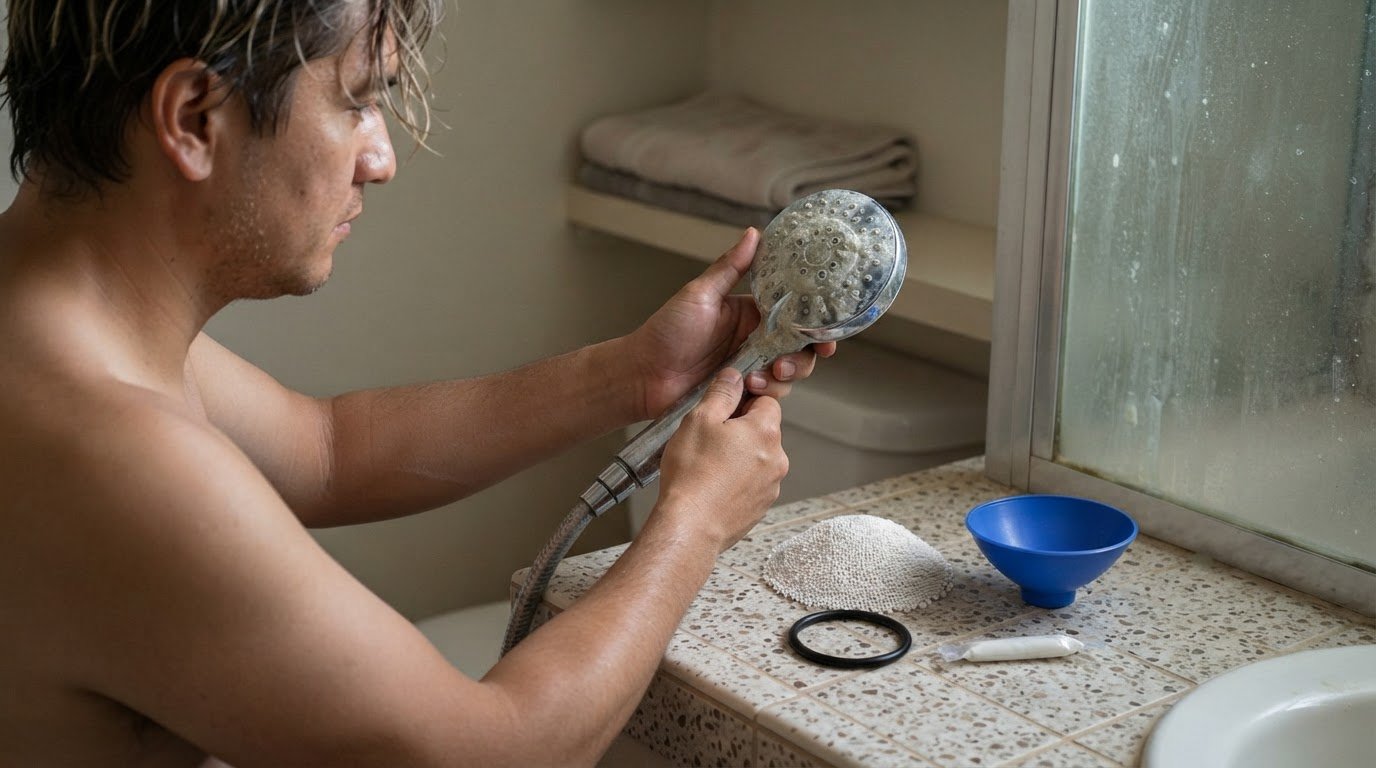
White or chalky deposits around faucets and showerheads, spots on dishes, and buildup in appliances can be clues that minerals are present. These signs can prompt further investigation, but they aren’t a reliable hardness test. Residue can have other causes, and appearance can’t identify specific substances in the water.
Mineral hardness describes calcium and magnesium in water; it doesn’t identify contaminants, which require separate testing and treatment. That distinction matters when choosing the best whole home water filter for hard water in Arizona. A filter’s ability to address one substance doesn’t automatically mean it reduces hardness or prevents scale. Define the problem with your report and test results, then match the system’s stated treatment purpose to that goal.
These systems address different goals. Compare their stated purpose with your test results, and use the U.S. Geological Survey’s explanation of hardness and its measurement in What is Water Hardness?
| System | Primary role | What to understand |
|---|---|---|
| Whole-home filter | Targets specified substances | Check which substances the system is designed and documented to reduce. Filtration alone doesn’t mean hardness is reduced. |
| Salt-based softener | Addresses hardness minerals | Softening is intended to reduce calcium and magnesium in the treated water. |
| Salt-free conditioner | Manages scale concerns | Conditioning may help manage scale, but it shouldn’t be described as removing hardness minerals or as conventional softening. |
Only if the system is specifically designed and documented to address hardness. Performance depends on the technology and the water conditions it’s designed for, so read product specifications rather than assuming that a “whole-home filtration” label means softening.
Filtration targets specified substances; softening addresses hardness minerals. This distinction helps you judge whether the best whole home water filter for hard water in Arizona fits your goal or whether you need a different treatment approach.
If your priority is reducing hardness, compare softeners designed for that purpose. If your focus is scale management, a salt-free conditioner may be relevant, but it isn’t interchangeable with a softener. Keep other goals, such as addressing a specified substance, separate when evaluating options. CastleGuard’s guide, Salt-Free Water Conditioner: How It Works and What to Expect, offers more context on conditioning.
If filtration is part of your plan, explore CastleGuard’s whole-home filtration option and compare it with your water-treatment goals.
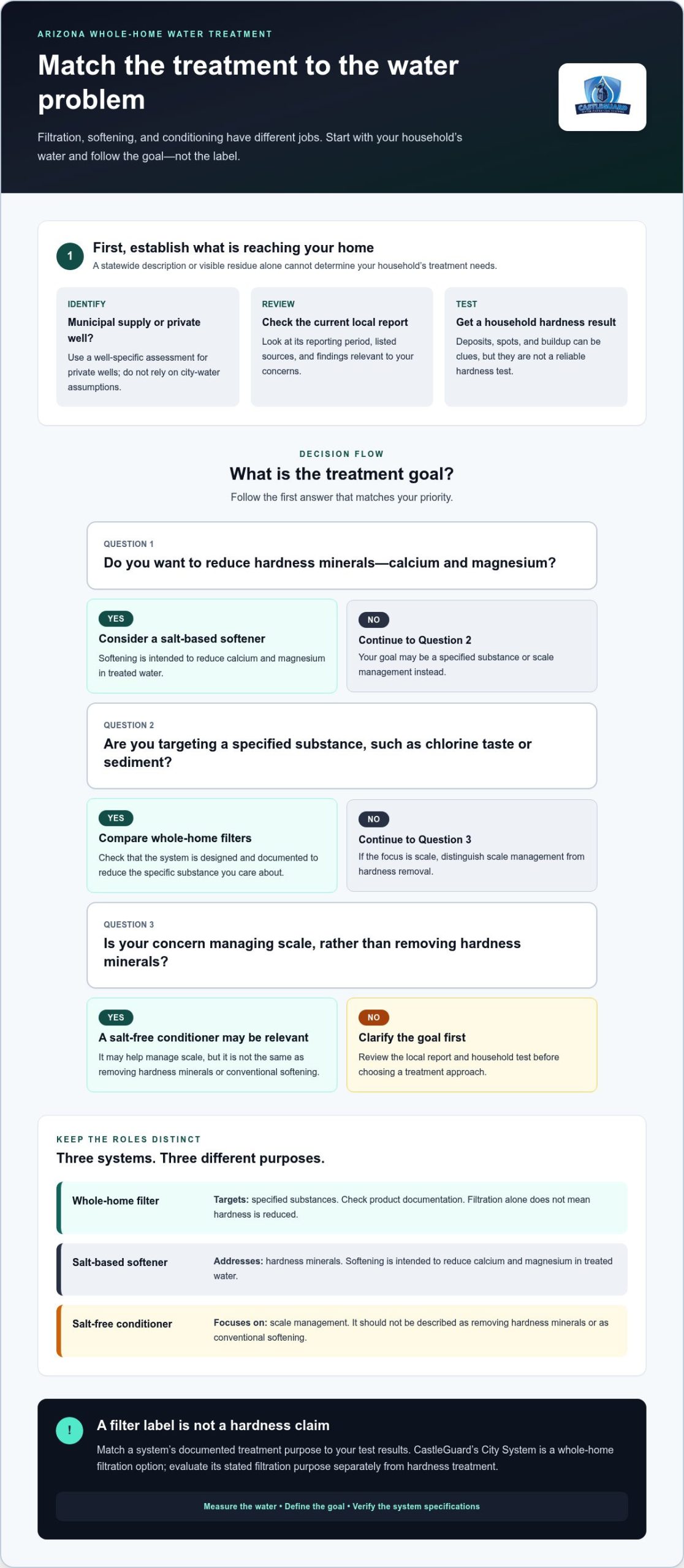
Use this sequence to connect your household’s water conditions and priorities to a system’s documented purpose. The best whole home water filter for hard water in Arizona is one that fits your treatment goal, not a statewide assumption.
Start with the water reaching your home. Municipal reports describe a community supply; private wells need a well-specific assessment and shouldn’t be judged using city-water assumptions. Compare the current provider report with your household test, then use the results to guide your choice. For municipal water, CastleGuard’s whole-house city-water guide provides related context.
Look for the exact substances or conditions a system is designed to address, along with any stated testing conditions. A claim about sediment or chlorine doesn’t establish hardness reduction. Likewise, conditioning claims shouldn’t be read as proof that hardness minerals are removed.
Consider household water use, too. Compare a system’s stated flow information with your household’s needs, rather than relying on a generic sizing rule. Before deciding, review maintenance instructions, access for routine care, and replacement-media information. These details help you understand what ongoing upkeep involves.
Use your results to explore CastleGuard’s whole-home water options and identify a filtration option that aligns with your goals.
CastleGuard Water Systems offers the City System as a whole-home filtration option. To assess its fit, define what you want treated and compare that goal with the system’s documented capabilities. If your main concern is hardness or scale, don’t assume a filtration system addresses it. Keep those goals distinct as you consider options for your home.
Use your water report and household test to clarify the concern, then compare the results with product information. A goal related to a specified substance calls for documentation that addresses that substance. A hardness-reduction goal calls for evidence that the system is designed to address hardness. This approach helps you evaluate the best whole home water filter for hard water in Arizona without relying on a product label alone.
Expect to match documented system capabilities to the water concerns you’ve identified, rather than assuming one system treats every issue. The City System is a whole-home filtration option; filtration shouldn’t be presented as softening or scale reduction without supporting product information. For ongoing care, review the system’s maintenance guidance and CastleGuard’s whole-house system maintenance guide.
Keep the decision focused: understand your household’s water, define the treatment goal, and compare that goal with documented system capabilities. If filtration fits your needs, consider the City System as part of your comparison. If hardness reduction is the priority, choose an approach specifically documented for that purpose.
For a practical next step, explore CastleGuard’s whole-home water protection options.
Keep your water test results and treatment priorities together as you compare options. Consider what matters in your home, from everyday water use to the maintenance you’re prepared to handle. This gives you a practical way to identify the best whole home water filter for hard water in Arizona without expecting filtration to solve a different problem.
CastleGuard Water Systems offers whole-home water protection systems for residential customers, with the City System as a priority offering. Consider it as a whole-home filtration option, and use its documented capabilities to judge how it aligns with your goals. CastleGuard also sells replacement media kits for existing systems, including carbon and salt-free conditioner kits, and offers automatic filter deliveries to support ongoing replacement needs.
Explore CastleGuard’s whole-home water protection options and take the next step for your home.
No. Arizona homes may receive water from different municipal supplies or private wells, so no statewide description fits every address. A Phoenix utility report describes that provider’s supply, not a nearby private well. The same address-specific approach matters in Southern California, Nevada, Texas, and Florida, where local supplies differ. Use the report tied to your service address rather than relying on a city average.
Start with the result you want. If a hardness test supports a goal of reducing calcium and magnesium, compare systems specifically documented for softening. If you’re concerned about a particular substance, taste, or sediment, look for filtration claims that address it. For example, a household focused on scale around fixtures has a different treatment goal from one focused on sediment in tap water.
Not in the same sense as a conventional softener. Salt-free conditioners are generally positioned for scale management, which doesn’t mean hardness minerals have been removed. If you want to assess whether water has been softened, compare hardness measurements before and after treatment. For scale concerns, review the specific conditioner’s documented claims and maintenance directions instead of assuming all conditioning systems work alike.
Use both when possible. A provider report gives context about the municipal supply and its reporting period, while a home test can help characterize water at your tap. If you use a private well, a municipal report won’t describe that source. Keep the report and test results together as you compare product documentation, especially if a change in water source or household plumbing could affect your results.