
What if your home’s water looks and tastes fine but contains a metal you can’t see? If you’re trying to remove heavy metals from water, start by identifying what is present. A filter that addresses one contaminant may not address another, so choosing a system before you know what is in your water can leave important questions unanswered.
Testing is the practical first step. Results can show which metals were measured and at what levels, helping you compare treatment options with your actual water conditions. Home test kits have limits, especially for health-critical contaminants, so it’s important to know when laboratory analysis is more appropriate.
This guide explains how to approach water testing, compare common treatment methods, and match a solution to the metals found and the water you want to treat. You’ll also learn what certifications, product-specific reduction claims, and maintenance details to review before making a decision.
“Heavy metals” is a broad term for metallic elements. It doesn’t confirm that your household water is contaminated or unsafe. The specific metal, its measured level, and how it enters the water all matter. For a general overview of the term and common sources, see What are heavy metals? Start by identifying your water source: municipal supplies and private wells call for different checks.
If you receive city water in the United States, review your utility’s Consumer Confidence Report (CCR) and current local guidance. Homeowners in Southern California, Nevada, Arizona, Texas, and Florida can also consult state or local health departments and environmental agencies for information relevant to their area. A report can help you frame questions about treatment, but it does not show everything about the water at your own tap.
A CCR summarizes water-quality information reported by a utility, including results for regulated contaminants and information about the water source. Use it to understand what has been measured in the public supply and whether local guidance has been issued. The report generally reflects the utility’s system, not conditions inside your home. Plumbing materials and fixtures can affect water after it enters the property, so a reassuring report is not a test of your household tap.
Consider testing if you rely on a private well, have concerns about your home’s plumbing, or need to know what reaches a particular tap. Private wells are not covered by the Safe Drinking Water Act, so owners are responsible for arranging appropriate testing. Use a qualified laboratory and follow its sampling instructions closely. The container, tap, and collection method can affect the sample. Don’t try to identify metals by appearance or taste. Water can look and taste normal even when testing is warranted. Results give you a sounder basis for deciding whether and how to remove heavy metals from water.
Household treatment methods work in different ways, and none should be assumed to address every metal. Treatment suitability depends on the contaminant, its measured level, and the system’s verified claim. Compare options with your test results and intended use. For broader context on drinking-water health goals, review the WHO guidelines for drinking water quality.
| Method | General principle | Household context | Key limitation to verify |
|---|---|---|---|
| Adsorption media | Contaminants attach to a filter material. | Used in some drinking-water and other filter systems. | Which metal the specific media is tested to reduce, and under what conditions. |
| Reverse osmosis | A membrane separates some dissolved substances from water. | Often used at a drinking-water tap; system design varies. | Product-specific reduction claims, operating conditions, and maintenance. |
| Ion exchange | Resin exchanges selected ions in the water for other ions. | Can be used in treatment systems designed for particular water concerns. | Which ions the resin targets and how water chemistry affects performance. |
With adsorption, selected contaminants attach to a filter medium as water passes through. Different media have different capabilities, so the words “carbon” or “filter” alone do not establish metal reduction. Reverse osmosis uses a membrane to separate some dissolved substances, but performance depends on the particular system and operating conditions. Neither method is a blanket solution for every metal or concentration.
No. Treatment claims apply to named contaminants and specified conditions. Check the product documentation for the metal tested, the stated reduction, and any operating conditions or replacement schedule. NSF/ANSI 53 applies to filters certified for reduction of specified health-related contaminants. NSF/ANSI 58 covers reverse osmosis systems and specified contaminant-reduction claims. NSF/ANSI 372 addresses lead-free components, not proof of metal reduction. These distinctions help you assess whether a system’s evidence matches your results and whether it may help remove heavy metals from water.
If your test results point toward treatment at multiple taps, include CastleGuard’s whole-home water protection options in your comparison. Evaluate any metal-reduction claim against the documentation for the specific product.
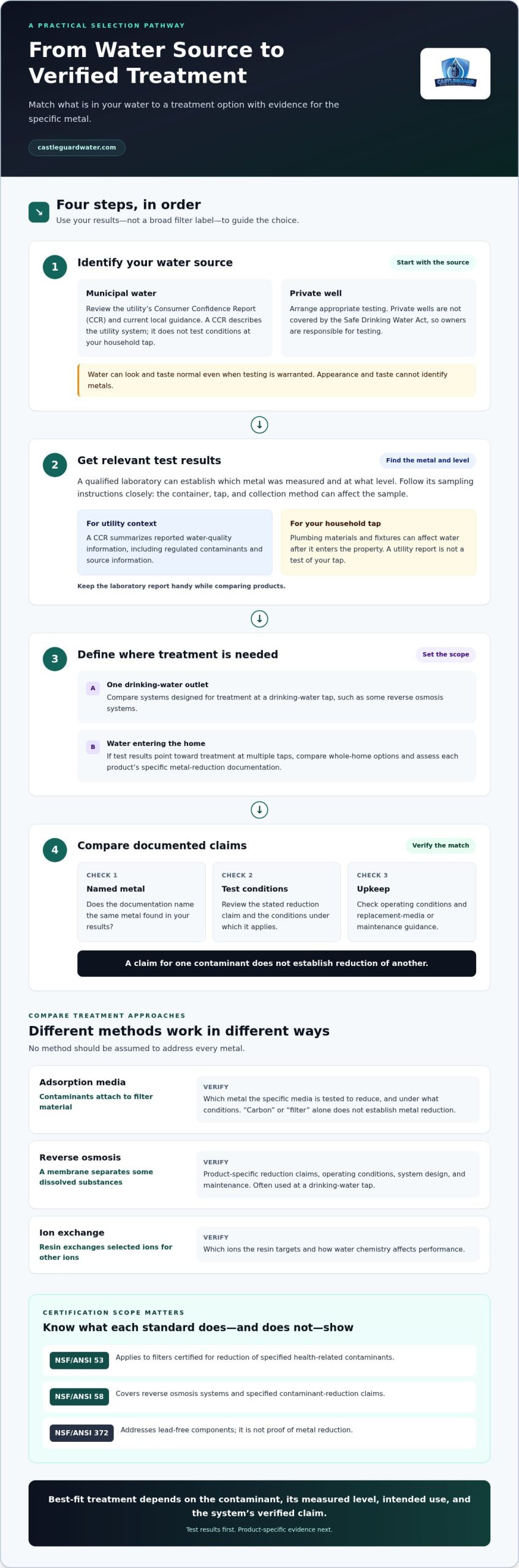
A clear selection process connects your test results to a treatment option instead of relying on broad labels like “whole-home” or “metal filter.” Work through these steps in order:
Check that the claim names the same metal identified in your results. A performance statement for one contaminant does not establish reduction of another. Review the conditions covered by the claim, including any stated limits on water characteristics or operation. Certification can support a particular claim, but its scope matters. Don’t extend it to contaminants or uses the documentation does not cover.
Point-of-use treatment focuses on water from a particular drinking-water outlet. A home drinking water system guide can help you consider that treatment scope. Whole-home treatment is positioned where water enters the house and treats water used at multiple taps. However, a whole-home setup does not by itself establish reduction of a particular metal. Compare your results with the whole-house city water filter guide as you assess this approach.
Choose based on intended use and evidence for the exact system, then follow the product’s replacement-media instructions. To explore residential options, view CastleGuard home water systems and compare each system’s treatment scope with your test findings before deciding how to remove heavy metals from water.
A sound treatment decision starts with what your water test found, then considers where you want treated water. Match the system’s documented performance claim to the specific metal and measured level. A broad label such as “whole-home filtration” describes treatment scope, not proof that a system reduces a particular contaminant.
CastleGuard’s City System is a whole-home water protection option to consider when comparing treatment scope. Judge its role in a metal-treatment plan against product-specific documentation rather than assuming performance from the system category. For a drinking-water-focused approach, explore the home drinking water system guide and consider how a point-of-use system fits your household’s needs.
Follow the maintenance and replacement-media instructions for the specific system you choose. Keep track of service intervals and use the specified replacement media, since neglected or overdue components may not perform as intended. A dependable plan pairs routine care with clear documentation of which contaminants the system is designed and tested to reduce. This keeps expectations grounded in evidence as your household’s water needs change.
Keep your water-test results with the treatment system’s performance documentation and maintenance instructions. Before choosing equipment to remove heavy metals from water, compare the named contaminant, test conditions, and intended use. If your results point to a concern at one drinking tap, focus your comparison there. If you want water treated as it enters the home, evaluate whole-home options while checking the exact claim.
For a practical next step, explore CastleGuard water systems and use your test results to guide the comparison. CastleGuard customer support is available Monday through Friday for questions about its residential systems.
Your water results can serve as a practical reference for future household decisions. Keep them with your treatment system’s documentation and maintenance instructions so you can review whether the equipment still fits your needs and whether its specific performance claims remain relevant. A thoughtful plan to remove heavy metals from water depends on evidence, suitable treatment scope, and consistent care, not a one-size-fits-all label.
CastleGuard offers residential whole-home and drinking water systems, with automatic replacement-media deliveries available to support ongoing upkeep. Customer support is available Monday through Friday. Compare the systems’ intended uses with your household’s priorities and test findings.
Explore CastleGuard’s home water systems and use your results to plan your next step. With clear findings and the right product information, you can make a considered choice for your home.
Yes, some filters are designed to reduce specific metals, but the product’s exact claim matters. To remove heavy metals from water, compare your results with documentation that names the same contaminant and states the conditions under which reduction was tested. Also review the system’s capacity and replacement schedule. A filter’s broad description alone cannot show whether it fits your drinking-water needs.
A laboratory test of water from your tap can identify metals that may enter through household plumbing, which a utility-wide report may not capture. If you have more than one tap of concern, test locations separately according to the laboratory’s instructions. For municipal water, check the current Consumer Confidence Report as background. It describes the public supply, not necessarily each home’s plumbing.
No. Boiling is not a dependable way to remove dissolved metals. As water evaporates, dissolved substances can remain in the smaller volume left behind, so boiling may not lower their concentration. Don’t use boiling as a substitute for testing or treatment. If you’re concerned about a particular metal, base your next step on test results and a treatment system’s documented claim for that contaminant.
There isn’t one best filter for every household. Lead and arsenic are distinct contaminants, and a system’s claim for one does not establish performance for the other. Compare your test result with documentation that names the metal and describes the conditions for the reduction claim. Then consider where you need treated water, such as a kitchen drinking-water tap or multiple outlets around the home.
Yes. Testing first can help you avoid buying treatment that does not address your actual concern. For example, a result identifying one metal gives you a more useful basis for comparing system claims than a general “heavy-metal” label. Keep the laboratory report, note which tap was sampled, and follow the lab’s collection instructions if you test again to check treatment performance.