Choosing a UV water purifier for well water Texas homeowners can rely on starts with understanding what a well-water test reveals. UV treatment can disinfect water, but it does not remove chemicals, metals, dissolved solids, or sediment. Cloudiness and suspended particles can also interfere with the light.
Your test results, water clarity, and household flow help determine whether UV belongs in your whole-home treatment plan and whether pretreatment is needed. This guide explains what UV can and cannot address, how to compare system requirements with your test results, and what to consider for capacity and ongoing lamp and filter maintenance. With a clearer picture of your water and treatment goals, you can make a more informed choice for your home.
A UV system can be part of well-water treatment when your test results and household goals point to microbial disinfection. It is not a complete purifier: UV light does not filter out sediment or remove metals, minerals, or chemical contaminants. A UV water purifier for well water Texas homeowners choose should therefore fit into a treatment plan based on test results, rather than replace water testing.
UV treatment is designed to inactivate susceptible microorganisms; it does not remove other contaminants that may be present in well water.
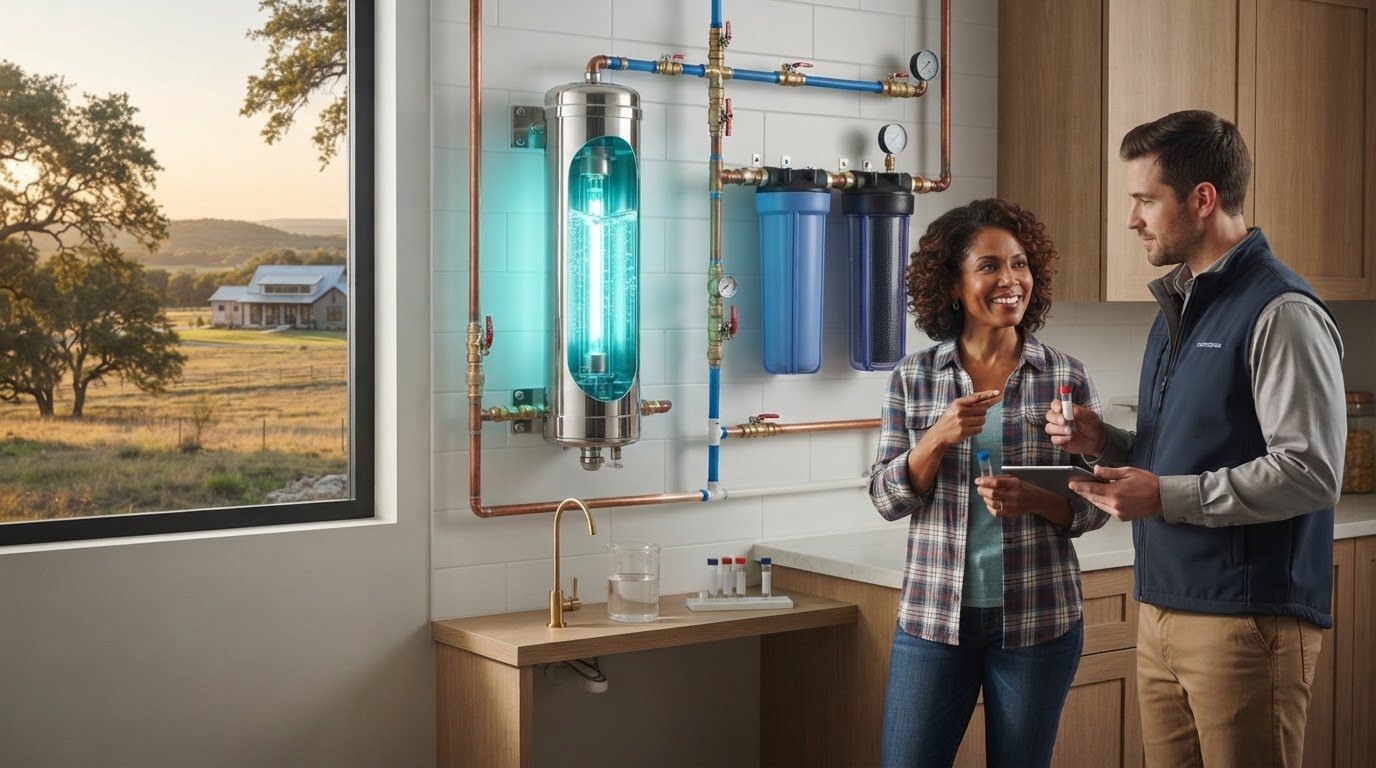
Inside a UV system, water flows past a lamp that exposes it to ultraviolet light. This exposure can damage the genetic material of susceptible microorganisms, preventing them from reproducing. The Ultraviolet germicidal irradiation overview explains this disinfection principle and its limits. UV does not physically remove organisms or capture particles, and it does not address dissolved substances such as metals, minerals, or chemicals. Those concerns call for treatment methods matched to the test findings.
Well-water quality varies across Texas because wells draw from different groundwater conditions. Even nearby homes may have different treatment needs. Start with a current laboratory test, then use the results to determine whether microbial disinfection is appropriate and whether other contaminants need attention. Testing for indicators such as total coliform and E. coli, along with nitrate and total dissolved solids, can help build a clearer picture of your water.
Use the lab report to guide your decisions. If it identifies a microbial concern, UV may fit the treatment goal. If it shows sediment, metals, or chemical contaminants, plan treatment for those findings as well. For broader context on matching treatment stages to well-water concerns, consult a well-water treatment systems guide before comparing equipment.
A UV system directs water through a chamber where a lamp exposes it to ultraviolet light. The light can inactivate susceptible microorganisms when water passes through the unit under the conditions it was designed for. Cloudiness and suspended particles can block or scatter the light, so clear-looking water alone does not establish that it is ready for UV treatment.
Turbidity, particles, flow rate, and maintenance all matter. Sediment or other material may shield microorganisms from UV exposure, while excessive flow can reduce exposure time. Check the system’s operating limits and maintenance instructions rather than assuming one specification applies to every well. If test results show sediment, iron, or other water-quality concerns, pretreatment may be needed to improve clarity before water reaches the UV chamber.
No. UV disinfection and filtration address different needs. A filter can capture certain particles or target specific substances, while UV is intended to inactivate susceptible microorganisms. Chemical contaminants and dissolved minerals require treatment suited to the test findings. For Texas well owners, the Texas Commission on Environmental Quality (TCEQ) on Water Wells explains the private-well context and why homeowners need to understand their own water quality.
UV disinfects; filtration captures particles, and other treatment methods address contaminants the light cannot remove. Use your lab results and the UV system’s requirements to determine whether sediment filtration or another pretreatment stage belongs ahead of the unit. A UV water purifier for well water Texas homeowners select should suit both the water conditions and household use, with maintenance performed as directed. CastleGuard offers ultraviolet systems for whole-home water-protection plans.
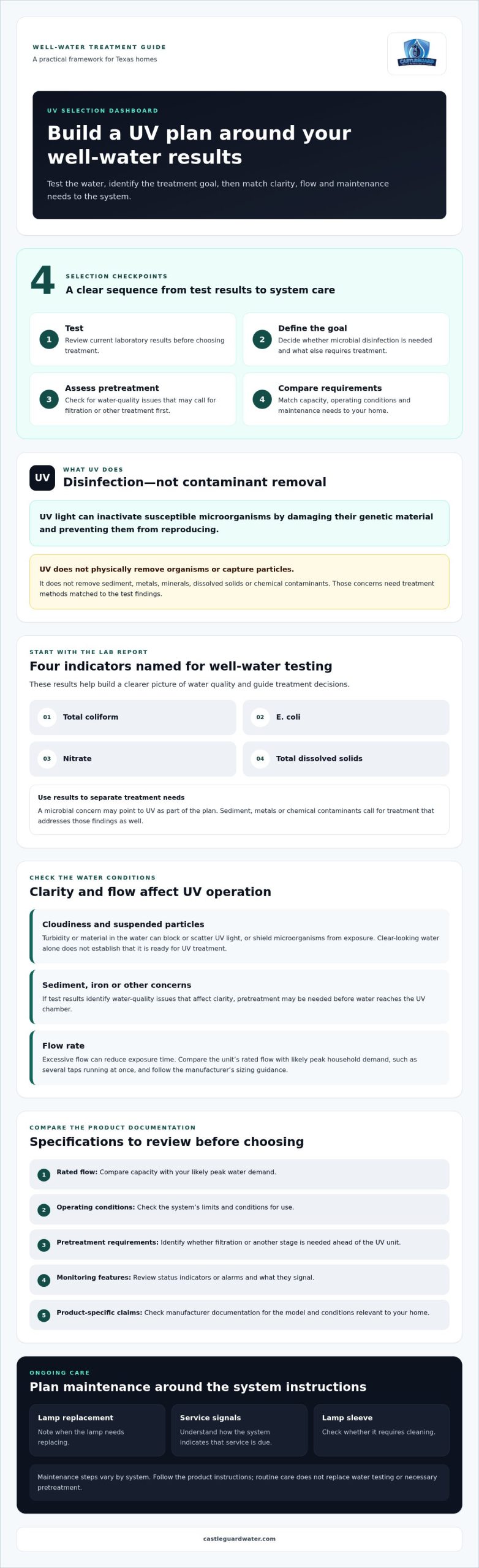
Start with your test results, then compare systems against your treatment goals and household needs. The Texas Water Development Board (TWDB) Private Well Resources provides information about well-water analysis and treatment considerations. Use this sequence to organize your selection:
Rated flow is an important comparison point for a UV water purifier for well water Texas households. Consider likely peak demand, such as when several taps are running at once, and compare it with the unit’s capacity. Follow the manufacturer’s sizing guidance instead of choosing by household size alone.
Review rated flow alongside the operating conditions and pretreatment requirements in the product documentation. Check whether the system includes monitoring features, such as status indicators or alarms, and what they signal. Performance claims and certifications are product-specific, so review the manufacturer’s documentation for the model and conditions relevant to your home.
Before choosing a unit, read its care instructions. Note when the lamp needs replacement, how the system indicates that service is due, and whether the lamp sleeve requires cleaning. Maintenance steps vary by system, so follow the product instructions rather than applying a generic schedule. Routine care helps the unit operate as intended, but it does not replace water testing or necessary pretreatment.
For more detail on UV system choices, use a dedicated UV water purification guide alongside the product documentation. CastleGuard sells ultraviolet systems for whole-home water treatment. View CastleGuard ultraviolet systems as you compare options against your water-quality needs.
A suitable whole-home UV system starts with your water, not a product label. For a UV water purifier for well water Texas households, consider four things together: current test results, the treatment goal, household flow, and the system’s maintenance requirements. CastleGuard offers ultraviolet systems as part of its range of whole-home water-protection products.
UV may fit when microbial disinfection is a defined household goal and your water conditions meet the system’s requirements. It should not be expected to resolve sediment, mineral, or chemical concerns by itself. If your test results identify those issues, include treatment suited to them. Consider how the stages work together, including pretreatment where test findings and product instructions call for it.
Keep your laboratory report and the system’s product documentation together while comparing options. This makes it easier to check whether the treatment purpose matches your results, whether rated flow suits household demand, and what care the unit requires. Note lamp replacement guidance, any applicable sleeve cleaning, and the manufacturer’s operating requirements so maintenance is part of the decision from the start.
When these points align, CastleGuard ultraviolet systems can be part of your whole-home well-water approach, alongside other treatment selected for your test findings. Explore CastleGuard ultraviolet systems and take your next step with a clearer understanding of your household’s needs.
Before choosing equipment, set aside your latest water-test report and note the questions it raises for your household. This turns a search for a UV water purifier for well water Texas families can feel confident about into a more focused decision. Keep your priorities practical: what you want the system to address, how it fits daily water use, and what routine care you can plan for.
CastleGuard offers ultraviolet systems for residential water-treatment needs and serves homeowners in Texas, as well as Southern California, Nevada, Arizona, and Florida. Compare the available UV system options with your water-quality goals in mind. A suitable plan should match your well and household needs, not simply rely on the number of claims made about a product.
Explore CastleGuard ultraviolet systems to compare whole-home options for your water-treatment plan.
No, a UV purifier alone cannot establish that well water is safe to drink. It may inactivate susceptible microorganisms when correctly selected, operated, and maintained, but it does not address every water-quality concern. For a UV water purifier for well water Texas households, use laboratory results to guide treatment and assess the water as a whole. If results raise concerns beyond microbes, include treatment suited to those findings.
Not always. Pretreatment depends on your water and the specific UV unit. If your sample contains suspended particles or appears cloudy, filtration may be needed so particles do not interfere with UV exposure. Compare your test findings with the product’s operating instructions. A sediment filter may address particles, while another treatment stage may be needed for a different water-quality issue.
A UV purifier does not remove dissolved minerals, metals, salts, sediment, or chemical contaminants. For example, a test showing elevated iron or a chemical concern points to treatment that targets that issue, not UV alone. Texas well conditions vary, so do not choose additional treatment based only on a neighbor’s results. Use your own laboratory report to determine which concerns need attention.
There is no single maintenance interval that applies to every UV purifier. Before choosing a unit, find the manufacturer’s instructions for lamp replacement, sleeve cleaning if applicable, and any alerts or status indicators. Add these tasks to a household calendar to help keep them from being overlooked. If an indicator changes or maintenance is due, follow the product guidance before relying on the system as usual.
A whole-home UV unit can treat water routed through it when its capacity and operating conditions suit the home’s plumbing and demand. Consider peak use, such as laundry running while someone showers, then compare that demand with the product’s rated flow and documentation. The unit’s treatment role remains limited to disinfection; other test findings may call for separate treatment stages.