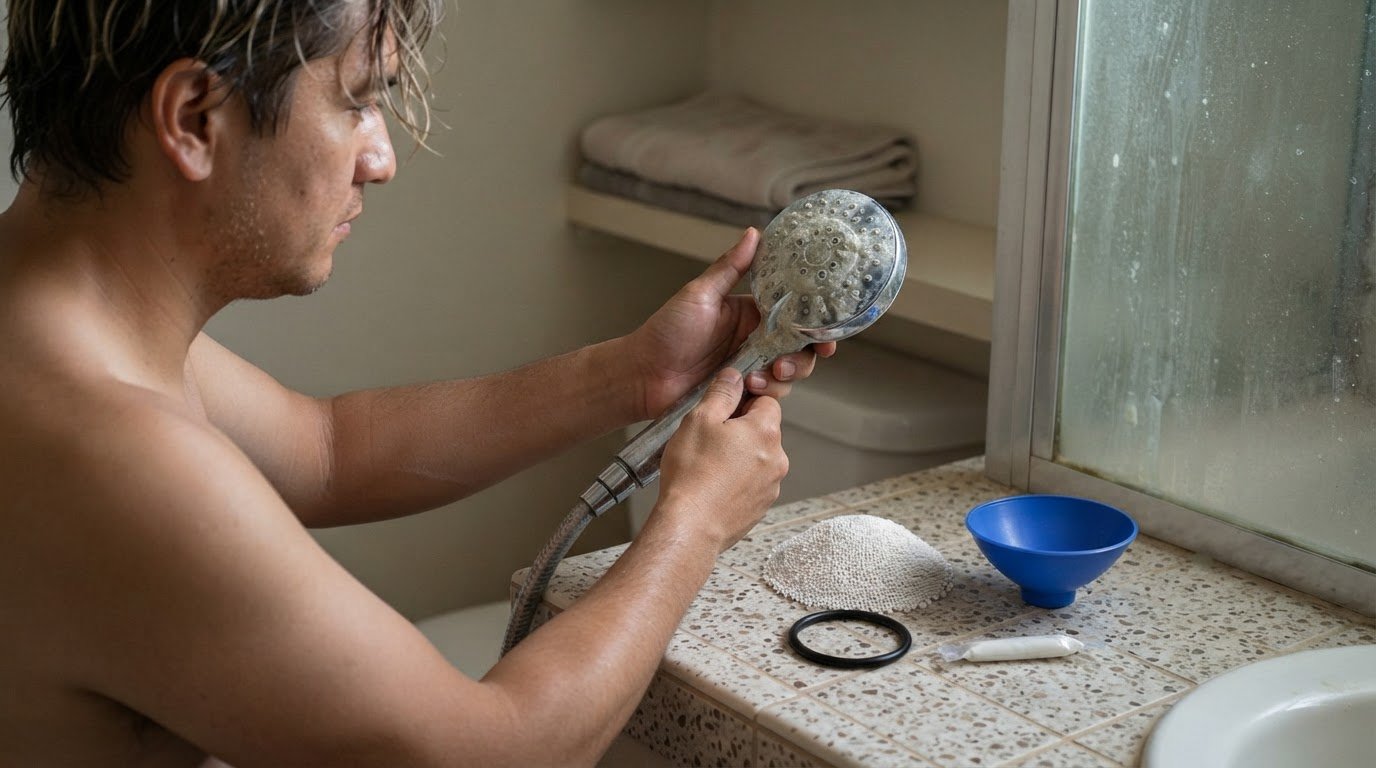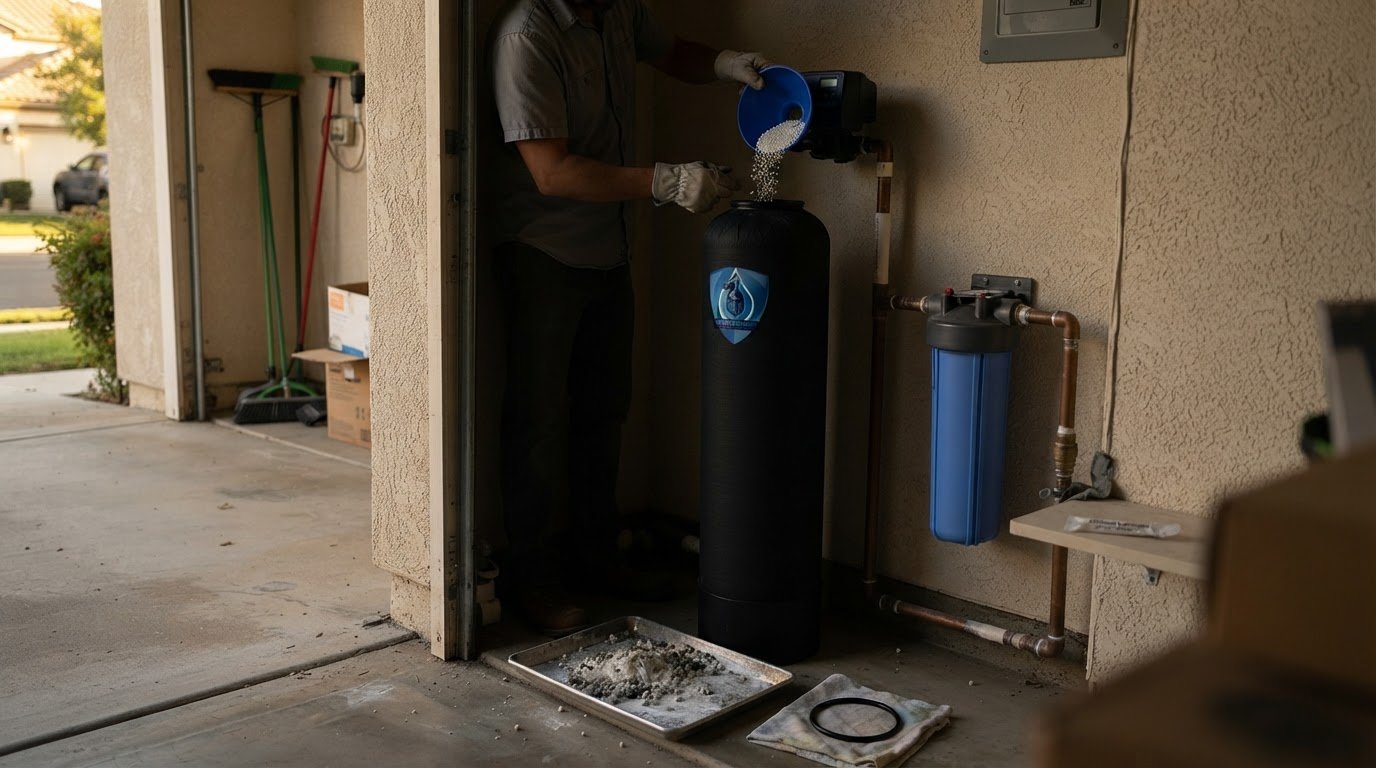

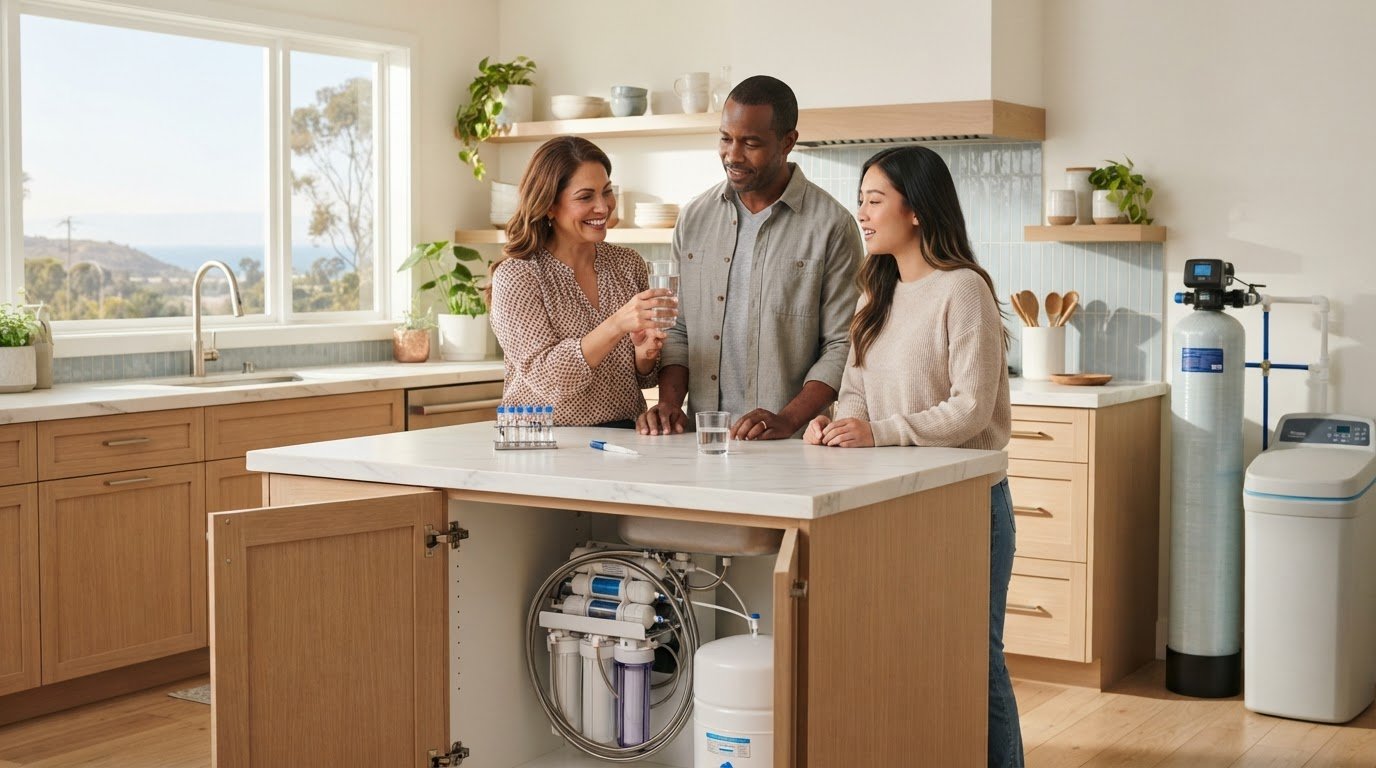
What if the right approach to healthy water for home starts with finding out what’s in your water, not choosing a filter? It’s natural to want clear answers about the water your household drinks and uses every day. But filtration, conditioning, softening, and disinfection address different concerns, so the right fit depends on your water source and goals.
Start by looking up your municipal water utility’s Consumer Confidence Report or finding out what testing is appropriate for a private well. Then match what you learn to the treatment method, placement, and upkeep that fit your needs. This guide explains how common approaches differ and why one system shouldn’t be expected to solve every water concern. For city-water households considering whole-home treatment, CastleGuard Water Systems offers the City System. Use the information about your water to make a more focused decision.
Healthy water for home depends on its source, quality, intended use, and the needs of the people in your household. Water for drinking and cooking may call for different considerations than water used for bathing or laundry. Rather than chasing a vague idea of “perfect” water, identify the concern you want to address and choose an approach suited to it.
Clear water can still contain substances you can’t see, smell, or taste. An unusual taste or odor, meanwhile, doesn’t prove that water is harmful or identify a specific contaminant. Treat sensory changes as a reason to look for reliable water-quality information or appropriate testing, not as a safety test. Improving taste or odor can be a valid treatment goal, but it’s different from resolving a health-related concern.
Water treatment methods work in different ways and serve different purposes. A broad overview of water purification methods can help explain why no single approach applies to every concern.
If your home receives municipal water, start with information from your local utility, such as its Consumer Confidence Report and current notices. The report describes the utility’s supply, but it doesn’t account for every home’s plumbing. Water may contact plumbing materials on its way to your tap, so the report is a useful starting point rather than a complete picture of every household’s water.
With a private well, there’s no municipal utility report covering your household’s water. Well owners need information and testing suited to their own supply. The right investigation depends on local conditions, which can differ across Southern California, Nevada, Arizona, Texas, and Florida. A regional label alone can’t tell you what’s in your home’s water.
Your goal also shapes where treatment may make sense. If you’re focused on drinking and cooking water at a particular tap, explore this drinking water system for home guide for point-of-use context. Start with what you know about your source, then narrow the question to the water and use that matter most to your household.
Healthy water for home isn’t a one-filter formula. Filtration captures or reduces particular substances, conditioning changes how water behaves, softening addresses hardness, and disinfection targets microorganisms. These functions aren’t interchangeable. Choose a method based on the specific water concern, where treatment is needed, and the system’s design and documented capabilities.
| Method | Typical purpose | Where treatment occurs | Key limitation |
|---|---|---|---|
| Carbon filtration | Improve certain taste or odor concerns and address substances specified for the filter | At a selected tap or where water enters the home | Performance depends on the filter and the substances it is designed to treat |
| Softening or conditioning | Address water hardness or its effects | Often where water enters the home | Doesn’t serve the same purpose as filtration or disinfection |
| Reverse osmosis | Treat water at a drinking-water tap for selected dissolved substances | Usually at a point of use | Capabilities vary by system; it isn’t a universal solution |
| Ultraviolet treatment | Disinfect water by targeting microorganisms | At a treatment point along the water supply | Doesn’t address chemical concerns or replace filtration |
A whole-home system treats water as it enters the house, while a point-of-use system serves a selected tap, such as the kitchen sink. If you’re considering broader filtration for municipal water, the whole-house city water filter guide offers more context. Choose placement according to whether your goal concerns water throughout the home or at a particular tap.
Carbon filtration, softening, conditioning, reverse osmosis, and UV treatment each have defined roles. A system’s actual performance depends on its design, maintenance, and documented treatment capabilities. The method name alone doesn’t show whether a particular system addresses your concern. For city-water households considering whole-home treatment, CastleGuard offers the City System. Explore the CastleGuard City System as you compare approaches.
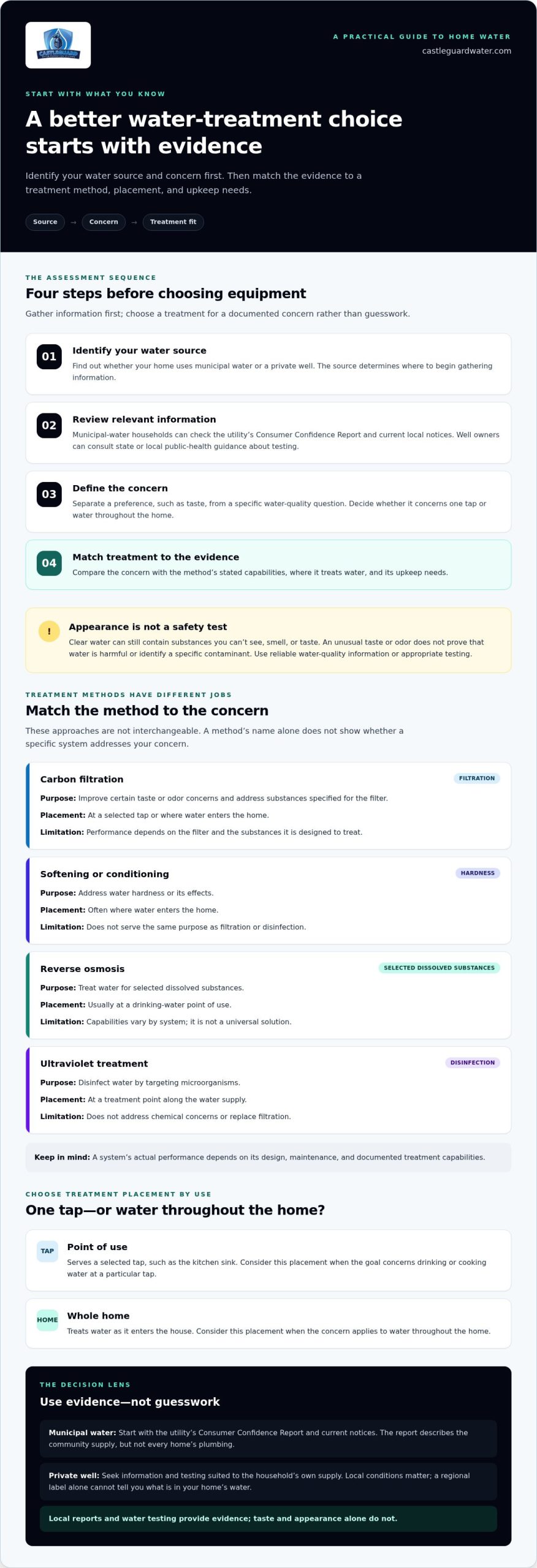
A simple process can turn questions about healthy water for home into a practical next step. Gather information first, then choose treatment based on a documented concern rather than guesswork.
Local reports and water testing provide evidence; taste and appearance alone do not.
For municipal-water information, start with the U.S. Environmental Protection Agency (EPA) and your local water utility. The utility’s Consumer Confidence Report describes the community supply, but it can’t account for every home’s plumbing. Use it as a starting point, then consider whether your concern relates to the water after it enters your home.
Water can be affected after it enters a property as it passes through household plumbing. A change in taste, color, or odor may be a reason to investigate, but symptoms alone can’t diagnose a contaminant or identify its source. If a specific concern involves metals, this guide to removing heavy metals from water offers focused information. For private wells, use relevant state or local public-health guidance to decide what testing is appropriate.
Once you have a clearer picture of your source and goal, explore CastleGuard water treatment systems as you consider an approach suited to your household.
A thoughtful choice begins with evidence and a clear goal, not the assumption that a single filter can handle every water concern. Use this checklist to compare options:
Keep the scope realistic. A system’s capabilities depend on its design, and one treatment approach shouldn’t be assumed to address every issue. Match the documented concern to the system’s stated treatment capabilities, then factor in placement and ongoing care.
If your household uses municipal water and your goal is treatment across multiple outlets, a whole-home system may be relevant. CastleGuard offers the City System for city-water households. Whether it fits depends on your water source, treatment goals, and the system’s documented capabilities. Define the need first, then decide whether whole-home placement suits your goal.
Treatment equipment needs upkeep according to its product instructions and household use. Build filter or media care into your home-maintenance routine, and follow the guidance for the specific system rather than assuming all products share the same schedule. CastleGuard offers replacement media and automatic filter deliveries to support ongoing care. Continue to follow the product instructions for your system.
With your source, concern, and treatment goal in view, you can make a more informed choice for healthy water for home. Explore CastleGuard’s City System for whole-home treatment in a municipal-water household.
Before choosing equipment, write down the water concern you want to address and what information would help you decide. This keeps your search for healthy water for home focused on your household’s needs rather than broad promises or features that may not apply. Compare options by their documented capabilities, placement, and the care they require over time.
CastleGuard offers whole-home equipment for city and well water applications. For homes served by municipal water, the City System is the whole-home option to explore. Its fit depends on your source and goals, so use what you’ve learned to decide whether it suits your needs. Explore CastleGuard’s City System and take a considered step toward a water approach that fits your household.
Not necessarily. Normal appearance and taste can’t confirm the absence of every water-quality concern, so don’t use your senses as a safety test. For healthy water for home, look for your utility’s current notices or seek appropriate testing if you rely on a private well. Conditions and notices can differ across Southern California, Nevada, Arizona, Texas, and Florida, so use information specific to your location.
No. Boiling can inactivate many disease-causing microorganisms when done according to public-health guidance, but it doesn’t remove chemical contaminants, metals, or salts. As water evaporates, some dissolved substances may become more concentrated. If officials issue a boil-water notice, follow their instructions for drinking, cooking, and other uses; boiling isn’t a substitute for treatment matched to a chemical concern.
It depends on the filter technology. A system designed to reduce dissolved substances, such as reverse osmosis, may also reduce some minerals, while other filters have different treatment purposes. Check the specific system’s documented capabilities rather than assuming all filters change mineral content in the same way. If mineral content matters to you, review the treatment information for the exact model you’re considering.
A filter used beyond its recommended interval may no longer perform as intended. Depending on its design and use, flow may decrease or the filter media may become less effective at addressing the substances it’s designed for. Don’t rely on taste or appearance to judge whether it’s still working. Follow the product instructions for replacement and care, and use the correct replacement media.
No. A whole-house filter treats water at the point where it enters the home, while a drinking-water filter treats water at a selected tap or point of use. For example, a household may want treatment at several outlets, while another may focus on the kitchen tap for drinking and cooking. Compare each system’s placement and documented capabilities with the water concern you’re addressing.