
What if the right time for carbon filter media replacement depends less on the calendar and more on your specific system? A whole-house media bed may last 5 to 10 years, while other carbon filters can have shorter replacement cycles. That range makes it important to check your equipment’s guidance before deciding when to act or which refill will fit.
It’s understandable to want a clear, safe way to maintain your household water without turning routine maintenance into guesswork. This guide covers signs that carbon media may need attention, how to identify compatible replacement media, and how to follow your system’s manual through the replacement process. You’ll also learn why a universal schedule can be misleading and what to consider before opening a media tank or cartridge housing. CastleGuard offers Carbon Kits for compatible systems. By the end, you’ll have a practical plan for handling this maintenance with greater confidence.
Carbon filter media is the treatment material inside a compatible filtration system. Depending on the system and media, it can help reduce certain substances that affect water’s taste or odor. The process, called carbon filtering, relies on contaminants attaching to the carbon’s surface. Over time, the media’s capacity and the system’s overall performance can change, so maintenance matters. The effect and service life vary by system.
Carbon media replacement means removing used treatment media and installing a compatible replacement according to the filtration system’s instructions. The key is to match the refill to the equipment and follow the manufacturer’s guidance for handling it.
A return of an unpleasant taste or odor, such as a chlorine-like smell, can be a reason to investigate. So can a noticeable change in water pressure, cloudy or discolored water, or faucet aerators that clog more often. These clues don’t prove that carbon media is exhausted. Other system components, incoming water conditions, or a separate plumbing issue may be involved.
Gradual changes can be easy to overlook, while a sudden change may have a cause unrelated to the media. Taste or odor alone also can’t show whether the system is reducing every substance it is designed to address. Treat sensory changes as prompts to review maintenance, not as a reliable test of filter performance.
Before deciding that carbon filter media replacement is due, check your system manual for its recommended interval and any signs that call for inspection. Compare that guidance with your maintenance records, including the last replacement and any service performed. Usage, source-water conditions, and equipment design can affect timing, so a general schedule may not fit your home. If symptoms continue or the manual calls for a specific check, follow its troubleshooting guidance before proceeding.
Start with the manual for your exact system. Its maintenance schedule and manufacturer guidance are more useful than a general online interval because replacement needs can vary with water use, incoming water conditions, and equipment design. A household using more water may put different demands on its filtration system than a home with lighter use, but that alone doesn’t establish a replacement date.
There isn’t one calendar interval for every carbon system. A whole-house tank filled with loose media is maintained differently from an under-sink unit with a replaceable carbon cartridge. A system may also have separate sediment filters or other components with their own service instructions. Replacing tank media when the manual calls for a cartridge change, or vice versa, can mean buying the wrong part and missing the maintenance task the equipment needs.
Before you shop, find the system model on its label or in your installation records, then compare it with the manual’s maintenance section. Look for the exact media or refill specified, and note whether the task is a tank-media replacement, a cartridge change, or another maintenance step. Keep the model information and replacement history together so the next service decision is easier.
This quick check makes carbon filter media replacement more straightforward and helps avoid assuming that all carbon media or filter parts are interchangeable. CastleGuard offers Carbon Kits for compatible systems. Compare the system model and the kit details, then use your system’s instructions to confirm the right fit for your equipment.
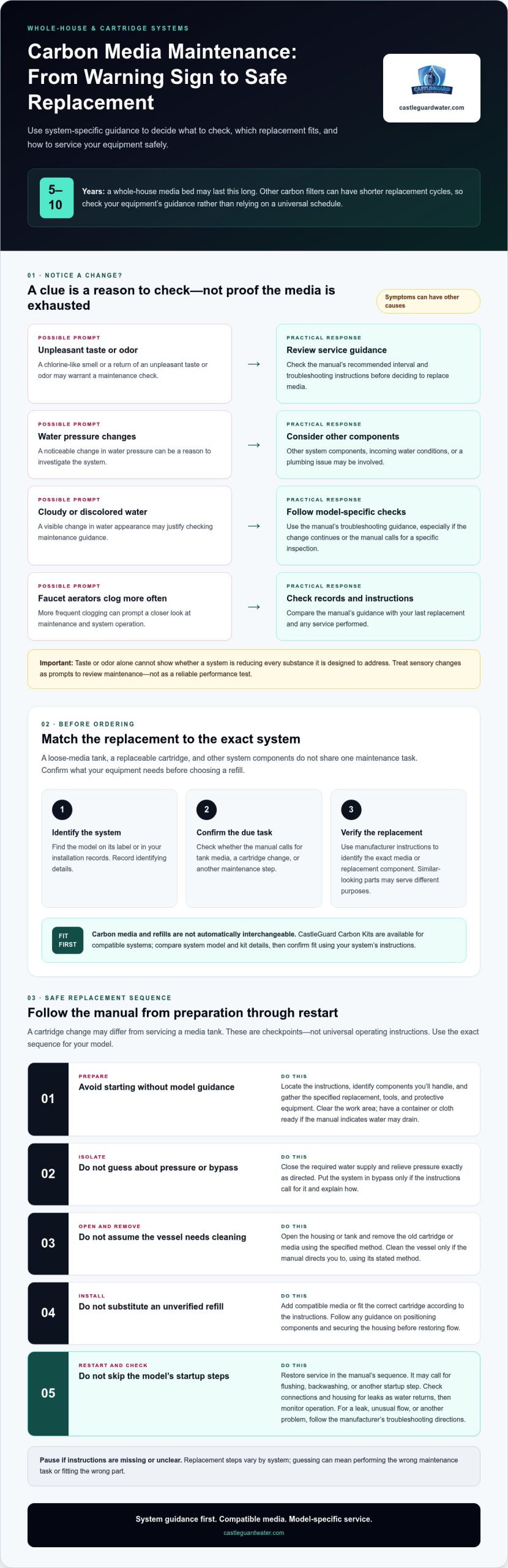
Isolate and service the system according to its manufacturer instructions. Carbon filter media replacement isn’t a universal procedure: a cartridge change may involve different steps from servicing a media tank. Use the manual for your exact model from start to finish. If instructions are missing or a step is unclear, pause rather than guessing.
Before beginning, gather the specified replacement media and any tools or protective equipment named in the manual. Then follow its sequence:
Restore service in the sequence described in the manual. It may require flushing, backwashing, or another startup step, but requirements vary by system. Check the connections and housing for leaks as water returns, then monitor the system’s operation. If you notice a leak, unusual flow, or another problem, follow the manufacturer’s troubleshooting directions and don’t continue operation contrary to them.
CastleGuard offers Carbon Kits for compatible systems. Match the kit to your equipment and follow the system-specific instructions during replacement.
The right refill is the one specified for your equipment, not simply a product labeled “carbon media.” Before ordering, compare your system model with the manufacturer’s instructions and the annual water filter maintenance kit compatibility details. Check the media type and whether the system uses loose tank media or a cartridge. Similar-looking refills may differ, and carbon media, tanks, and cartridges aren’t automatically interchangeable.
CastleGuard Carbon Kits are replacement options for compatible systems. Use your model information and the relevant product details to match a kit to your equipment; don’t assume every kit fits every system or contains the same components. Keeping a note of the model, replacement date, and manual’s maintenance guidance can make your next carbon filter media replacement easier to plan.
A simple maintenance record helps you track what was replaced and when, while the system manual remains your guide to the next service interval. Automatic filter deliveries are also available to help keep routine maintenance on your radar, rather than relying on memory alone. They don’t replace the need to follow the schedule and compatibility instructions for your specific system.
For broader upkeep, the whole-house water system maintenance guide can help you consider carbon media as part of an ongoing home maintenance routine. If you have a City System, the whole-house city water filter guide offers related system context.
Compare your system details with CastleGuard Carbon Kit options for compatible equipment. CastleGuard customer support is available Monday through Friday as a weekday resource while you plan routine filter maintenance.
Turn today’s system check into an easier decision next time. Keep the model information and manual somewhere accessible, and note when maintenance is completed. When the manufacturer’s guidance indicates carbon filter media replacement is due, you’ll have a clear reference point instead of relying on memory or a one-size-fits-all schedule.
A little preparation can make home water-system care feel more manageable. Before choosing a refill, use your system details to narrow down a compatible option, then follow the equipment’s instructions as you plan the work. When you’re ready, explore CastleGuard Carbon Kits for compatible systems.
With a reliable record and the right replacement approach, routine upkeep can become a simpler part of caring for your home. Take it one step at a time, and let your system’s guidance lead the way.
No. Carbon media isn’t a universal treatment, and what it addresses depends on the specific media and system. For carbon filter media replacement decisions, consult the equipment documentation to see which contaminants the system is designed to reduce. Compare that information with relevant water-quality details for your supply. Homeowners in Southern California, Nevada, Arizona, Texas, and Florida should use information specific to their own water source, rather than assuming one system addresses every concern.
No. Carbon filtration and water softening address different water-treatment needs. Carbon media shouldn’t be treated as a substitute for a softener or conditioner. If your concern is mineral scale on a faucet, spots on dishes, or buildup in appliances, identify it as a hard-water concern and review the documentation for your equipment. It explains which treatment approach your system is designed to provide.
Activated carbon is carbon processed for use in filtration; ordinary charcoal isn’t automatically suitable for treating water. Household charcoal may differ in composition, preparation, and intended use, so it shouldn’t be poured into a filter tank as a substitute. Use only replacement material that matches the system’s specifications. If a package simply says “charcoal,” that wording alone doesn’t establish compatibility with your equipment.
Disposal depends on the media, what it has been exposed to, and local waste guidance. Don’t assume used media is suitable for household trash, a drain, or compost. Review the system instructions and follow your local waste authority’s direction. If the system treated water with contaminants that may require special handling, get disposal guidance specific to those materials before discarding the media.
It depends on your plumbing layout, the system’s bypass arrangement, and the service procedure. Shutting off the supply may affect water access, while bypassing equipment may change how water flows through the home. Check the manual before starting, and don’t assume a bypass valve works the same way on every system. Plan household water use around the instructions for your specific equipment.