An estimated 8.9 million Floridians have PFAS in their drinking water, so PFAS can be present in Florida tap water. The EPA’s 2024 national drinking water standard sets an enforceable limit of 4 parts per trillion for PFOA and PFOS. Choosing a PFOA water filter in Florida means comparing filtration methods and how they address PFAS, not relying on a statewide estimate to describe your home’s water.
It’s understandable to want a practical way to protect your household without guesswork. This guide explains how reverse osmosis and activated carbon compare for PFAS reduction, why pitcher filters may not perform consistently, and what to consider when comparing filter life and replacement costs. You’ll also learn how to interpret local water-quality information and where whole-home and drinking-water systems fit, so you can choose an option suited to your household.
Reverse osmosis can reduce PFAS in drinking water, but local results and filter evidence matter. Florida utility reports and a filter’s tested performance answer different questions.
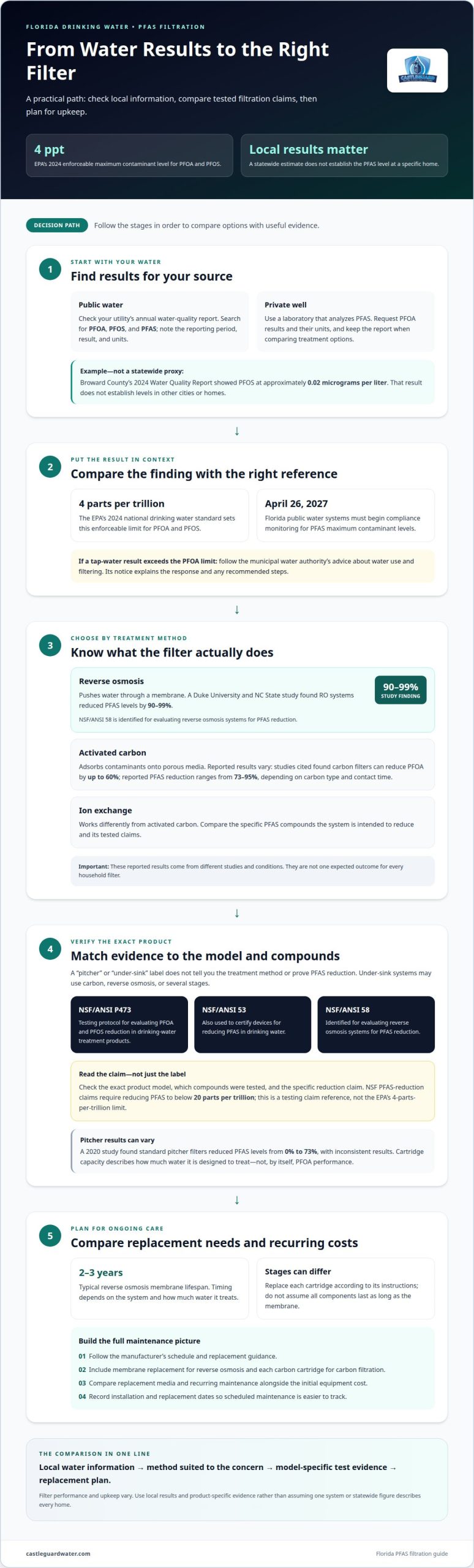
The EPA’s 2024 national drinking water standard sets an enforceable maximum contaminant level of 4 parts per trillion for PFOA and PFOS, according to the U.S. Environmental Protection Agency. Florida public water systems must begin compliance monitoring for PFAS maximum contaminant levels on April 26, 2027.
To check an annual water quality report, search its contaminant tables for “PFOA,” “PFOS,” and PFAS, then note the reporting period, result, and units. Broward County’s 2024 Water Quality Report showed PFOS at approximately 0.02 micrograms per liter. Clearwater, Largo, Port Richey, and St. Petersburg residents should read the report for their own utility; one county’s result doesn’t establish another city’s levels.
A Duke University and NC State study found reverse osmosis systems reduced PFAS levels by 90-99%. NSF/ANSI 58 is the standard identified for evaluating reverse osmosis systems for PFAS reduction.
If a tap-water result exceeds the PFOA limit, follow the municipal water authority’s advice about water use and filtering. The 4-parts-per-trillion limit gives residents a reference point, while the utility’s notice explains its response and any recommended steps.
Private-well owners can have water tested by a laboratory that analyzes PFAS. Request PFOA results and their units, and keep the report when comparing treatment options. A well test applies to the sampled water. Exposure to unsafe PFAS concentrations in drinking water may have developmental, cancer, liver, immune, and thyroid effects.
For a Pure XP pitcher, compare its model-specific PFAS reduction test with its stated filter capacity. Capacity describes how much water the filter is designed to treat before replacement; it isn’t, by itself, evidence of PFOA reduction. Across the United States, at least 45% of tap water could contain one or more forms of PFAS, and PFAS affect drinking water and groundwater in more than 7,000 communities. These figures don’t determine levels at a specific Florida home.
Some pitcher filters reduce PFAS, but performance varies by filter media and testing. When choosing a PFOA water filter in Florida, look beyond labels such as “pitcher” or “under-sink” and check the tested claims for the specific model.
NSF/ANSI P473 is a testing protocol for evaluating PFOA and PFOS reduction in drinking water treatment products. A test result gives you a clearer comparison than a broad claim that a filter removes “chemicals.” Check whether testing covers both compounds and the exact product model. NSF PFAS-reduction claims require reducing PFAS to below 20 parts per trillion.
Certification and performance claims apply to the product and conditions tested, not every filter in a household. NSF/ANSI Standard 53 is also used to certify devices for reducing PFAS in drinking water. Review the listing for the model, the contaminants named, and the specific reduction claim before comparing products.
Activated carbon captures some PFAS compounds as water passes through its porous media. Studies cited in the research found carbon filters can reduce PFOA by up to 60%, while reported PFAS reduction ranges from 73-95%, depending on carbon type and contact time.
Those figures reflect different results, not one expected outcome for every household filter. A 2020 study found standard pitcher filters reduced PFAS levels from 0% to 73%, with inconsistent results. Check the specific filter’s tested claim and replacement guidance; used-up media may not perform like a fresh cartridge.
Reverse osmosis pushes water through a membrane, while activated carbon adsorbs contaminants onto its media. “Under-sink” describes a unit’s location, not its treatment method. An under-sink system may use carbon, reverse osmosis, or several treatment stages, so compare its actual technology and PFOA/PFOS test claims.
For a household choosing between options, prioritize evidence tied to the compounds of concern. Reverse osmosis systems evaluated under NSF/ANSI 58 and products tested for PFAS reduction offer different comparison points. A pitcher’s capacity describes how much water its cartridge is designed to treat, not its PFOA performance. A PFOA water filter in Florida should be selected by its model-specific claims and maintenance needs.
Maintenance affects both treatment performance and household costs. Before choosing a system, compare cartridge replacement needs, membrane life, and maintenance schedules. A low purchase price alone doesn’t reveal the ongoing care a system requires.
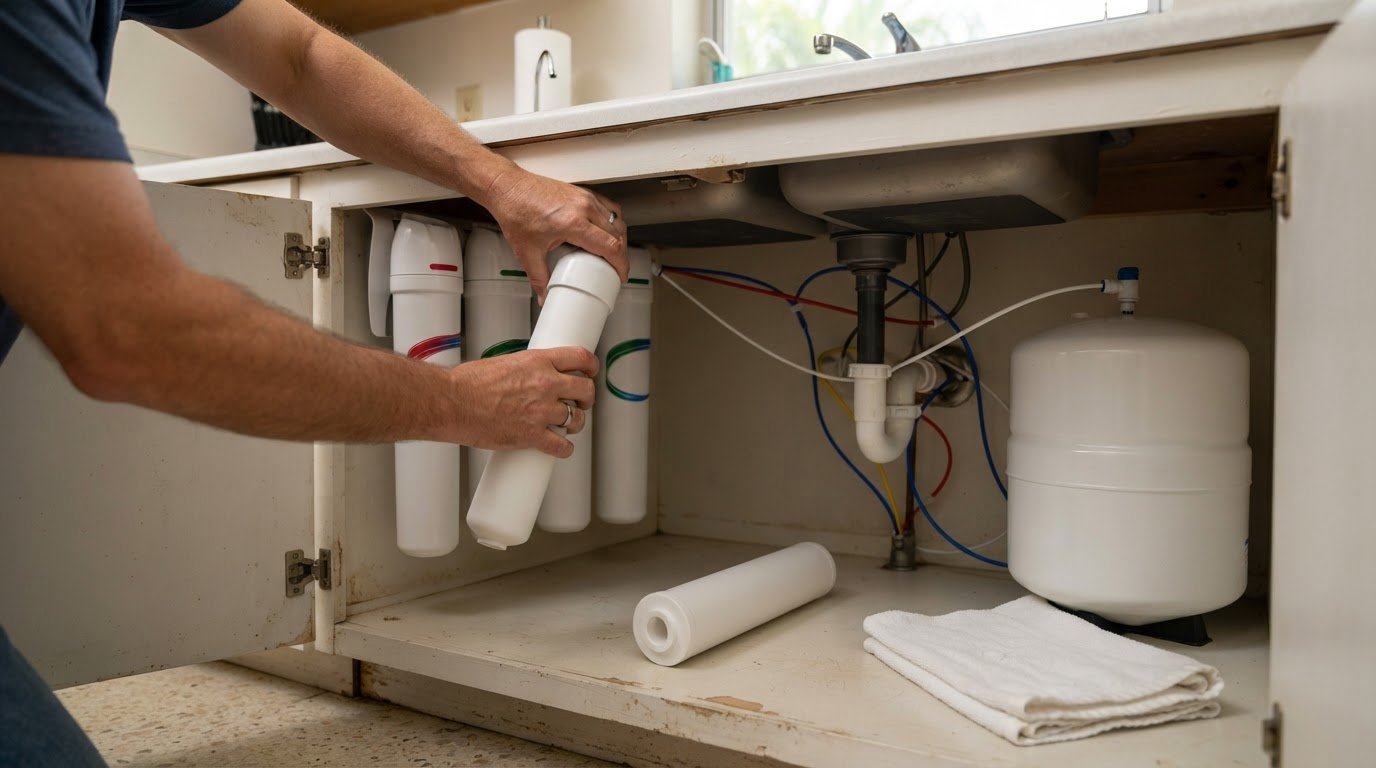
Reverse osmosis membranes typically last 2-3 years. Their replacement timing depends on the specific system and how much water it treats. A household using filtered water for drinking and cooking may use its system differently from one filtering drinking water alone. Follow the manufacturer’s schedule, and replace the membrane when required to maintain the system’s intended operation.
Different filter stages may need replacement at different intervals. Follow the instructions for each cartridge rather than assuming all components last as long as the membrane. Record installation and replacement dates to make scheduled maintenance easier and avoid overlooking an overdue cartridge.
Replacement costs depend on the system’s stages, required parts, and how often those parts need changing. Compare the ongoing cost of replacement media with the initial equipment cost. For reverse osmosis, include membrane replacement; for carbon filtration, account for each carbon cartridge. Treatment needs and household water use also affect the maintenance plan.
EWG’s first-year filter-cost estimates used a four-person household filtering 2 gallons of water per day for drinking or cooking. That example shows why household use matters when comparing estimates: a different amount of filtered water changes how quickly media reaches its capacity. A filter’s rated capacity and replacement instructions are more useful for planning than a lifespan assumption borrowed from another household.
To choose a PFOA filter for home use, compare tested PFAS-reduction claims, rated capacity, and replacement guidance. Install the system according to its instructions, then replace cartridges and membranes on schedule. Regular maintenance supports consistent treatment, but a filter’s lifespan alone does not prove its PFAS-reduction performance.
PFAS, sometimes called “forever chemicals,” are a large family of substances that includes perfluoroalkyl and polyfluoroalkyl substances. Activated carbon and ion exchange work differently, so compare evidence for the specific compounds detected, including PFOA and PFOS.
Activated carbon media attracts and holds some contaminants as water passes through. Performance depends on factors such as carbon type and contact time, so the general label “carbon filter” does not establish PFOA reduction. Look for a tested claim naming the relevant PFAS compounds and exact filter model. Replace the media according to its capacity and instructions.
Ion exchange resins use charged sites to capture certain dissolved substances and exchange them for other ions. Reported results indicate 90% or greater removal for most PFAS compounds. “Most” matters: it doesn’t mean every resin removes every PFAS equally. Check whether the product’s performance information addresses the compounds detected in your water.
Do not judge either filtration method by taste or clarity alone. PFOA and PFOS cannot be reliably identified by appearance, and better taste does not demonstrate PFAS reduction. Compare test claims, treatment method, and replacement guidance together. If carbon is one stage in a multistage system, identify which stage is responsible for the stated PFAS performance.
For household water treatment, choose media based on the PFAS reduction evidence and maintenance plan, not the technology name alone. CastleGuard’s Carbon Kits offer a carbon-based option; explore Carbon Kits for water filtration as you compare suitable treatment approaches. The right comparison connects the contaminants of concern with a filter’s tested claims and the upkeep required to keep filtration on schedule.
For households using municipal water, CastleGuard’s City System is an option to consider for treatment at home. Choose a system based on your water source and the contaminants you want to address, rather than assuming every system targets PFOA. For drinking water at a specific tap, CastleGuard’s Drinking Systems may be relevant alongside your whole-home treatment needs.
If your home uses a private well, CastleGuard’s Well Water Systems are designed for a different water-source context. CastleGuard also offers Ultraviolet Systems, but they should not be treated as a substitute for filtration designed to reduce PFAS. Matching the system type to your home’s water and treatment goals makes the decision more practical.
For help considering CastleGuard’s City System or other suitable water-treatment options, contact CastleGuard.
Choosing a PFOA water filter in Florida means considering your water source, test results, and treatment goals. Use those details to identify what you want treated and where treatment is needed. Match the system to the contaminants of concern, and choose a maintenance plan that fits your routine.
CastleGuard offers City System and Well Water Systems for different water sources, as well as Ultraviolet Systems for another treatment need. These options are not interchangeable, so focus on the system that aligns with your home’s water and priorities. Clear treatment goals make it easier to choose a practical next step.
For help exploring water-treatment options for your home, contact CastleGuard about water filtration. A thoughtful choice can bring greater clarity to your household’s water-care plan.
Yes, PFAS have been detected in Florida drinking water, though levels differ by water source and location. An estimate cited in reporting puts the number of Floridians with PFAS in drinking water at 8.9 million. That statewide estimate doesn’t tell you what’s in a particular home’s tap water. Public water and private wells also have different testing and reporting pathways.
PFAS are a family of synthetic chemicals, and PFOA is one compound within that family. The family includes more than 15,000 chemicals, so “PFAS” doesn’t identify one substance or one test result. PFOA has been detected in Florida drinking water, but a household’s exposure depends on its water source and the compounds present. A result for one PFAS doesn’t describe all PFAS.
Look for a model-specific PFAS reduction claim under NSF/ANSI Standard 53 or NSF/ANSI 58, then confirm which compounds the claim covers. Standard 53 is used to certify drinking-water treatment devices for PFAS reduction; Standard 58 evaluates reverse osmosis systems for PFAS reduction. A standard number alone isn’t enough: the product’s listing should identify PFOA or PFOS and the specific reduction claim.
Total cost depends on the filtration method, system design, replacement parts, and how much water your household treats. Compare the initial system cost with ongoing cartridge or membrane expenses, taking each component’s capacity and replacement schedule into account. A pitcher cartridge and a multistage under-sink system, for example, have different maintenance needs. Expected water use also makes cost comparisons more meaningful.