

The best water filter for Houston, Texas, water depends on what you want to treat and whether you need filtration at one tap or throughout your home. Houston’s Main System water averaged 110 mg/L hardness as calcium carbonate in the city’s 2024 report, so start by matching a system to your utility’s water quality report rather than choosing by a broad “whole-home” or “under-sink” label.
DIY can work when you’re comfortable choosing, installing, and maintaining a system for a specific need. Professional guidance can help you interpret a water report, compare treatment types, and plan whole-home treatment. Either way, match the system’s certified claims to the contaminants identified in the report.
This guide compares DIY and professional approaches, point-of-use and whole-home systems, and how to check treatment claims against your utility’s report. Use it to choose a system that suits your household’s water and your comfort with routine maintenance.
DIY suits a straightforward filter when you can follow its installation and maintenance instructions. Whole-house water filtration installation is more involved: the unit connects to the home’s incoming water line, so placement, plumbing, and flow needs matter. A professional can assess those details and help select a system for the contaminants named in your utility report.
For whole-house treatment, choose filtration based on the issue, not a broad “best” label. The United States Geological Survey classifies water hardness of 61-120 mg/L as moderately hard. Hardness comes from calcium and magnesium; a softener addresses it, while a filter selected for other contaminants may not. The U.S. Environmental Protection Agency’s 2024 rule set a 4.0 parts per trillion MCL for PFOA, making contaminant-specific treatment an important consideration.
What are the best whole-house water filters for Houston homes, including options for hard water? Choose a whole-house filtration system that targets the contaminants in your report, and add a water softener when hardness is the concern. A water treatment professional can help assess the incoming water and plumbing before installation.
| Option | Best fit | Considerations |
|---|---|---|
| DIY point-of-entry filter | Hands-on homeowners | Confirm the system suits the plumbing and target contaminants. |
| Professional whole-house installation | Complex plumbing or multiple treatment needs | Discuss placement, flow, and ongoing maintenance. |
| Water softener | Hardness from calcium and magnesium | Softening is distinct from contaminant filtration. |
Treatment certification describes what a system is tested or certified to reduce; it does not replace applicable plumbing requirements. Before installation, check the requirements that apply to your home and the specific work planned.
The total cost depends on the system, treatment needs, any plumbing changes, and replacement media. Compare those factors, along with ongoing maintenance, rather than relying on a single price.
Follow the system’s replacement schedule, taking its media type and water use into account. Replacement costs vary by model and media, so include recurring parts when comparing options. CastleGuard sells replacement media kits for its carbon, salt-free conditioner, and softener systems.
Choose DIY for a simple, manageable setup; choose professional help when whole-house plumbing, softener installation, or several treatment needs make the decision more involved.
To choose the best water filter for Houston Texas water, first decide where treatment is needed. A point-of-use system treats water at a selected outlet; a point-of-entry system treats it as it enters the home. The right choice depends on your goals and the concerns identified in your utility report.
A point-of-use system treats water at one outlet, such as the kitchen sink. It suits households focused on drinking and cooking water rather than every tap, shower, or appliance. Under-sink reverse osmosis is one example, delivering treated water to a dedicated faucet. Compare the system’s stated contaminant reductions with your report before choosing a model.
A point-of-entry system treats water as it enters the home, before it reaches individual taps. This can suit goals that extend beyond drinking water to bathing or household equipment. Identify the concerns you want to address, then match them to the system’s stated treatment claims.
Are reverse osmosis filters necessary for Houston tap water, or is a carbon filter sufficient? Neither is automatically necessary; compare the report’s findings with each system’s certified contaminant reductions. Carbon filtration can target specified contaminants, while reverse osmosis uses a membrane and filters. A described three-filter reverse-osmosis system targets chlorine, lead, copper, and other minerals, and can remove up to 99% of contaminants. Those claims don’t mean every system addresses every concern.
Tankless reverse-osmosis systems differ from models that store treated water in a reservoir. Compare their configurations, replacement-filter instructions, and contaminant claims rather than assuming that tankless means broader treatment. Testing can help assess whether a selected system addresses your concern. The best water filter for Houston Texas water is the one that suits your intended use and has documented claims relevant to your needs.
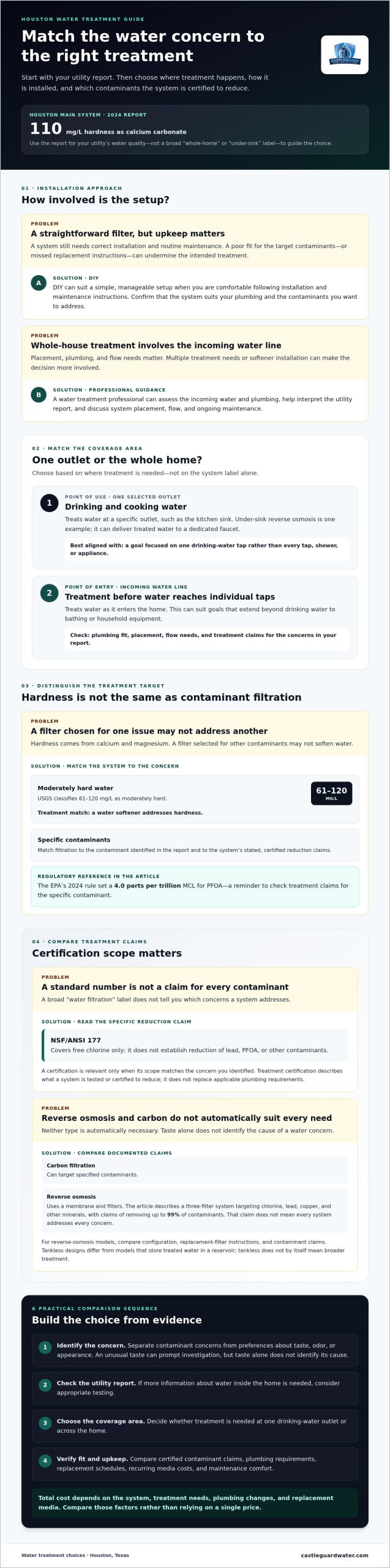
Start with the contaminant or water concern you want to address, then compare treatment claims. A certification is relevant only when its scope matches that concern.
Separate measurable contaminant concerns from preferences about taste, odor, or appearance. An unusual taste can prompt investigation, but taste alone does not identify its cause. Start with your utility’s water quality report, then consider appropriate testing if you need information about water inside your home. For example, a report naming lead calls for a different treatment target than a concern about chlorine taste.
Write down each concern before comparing products, including where it occurs, such as one drinking-water faucet or several taps. This helps you decide between point-of-use and whole-home treatment without assuming one system addresses every issue.
Read the specific reduction claims attached to a certification, not just the standard number on a label. NSF/ANSI 177 covers free chlorine only, so it doesn’t establish reduction of lead, PFOA, or other contaminants. Match the certification and product claim to the contaminant you identified; a broad “water filtration” label doesn’t tell you which substances a system addresses.
Compare the certification scope, contaminant name, and intended use together. Faucet-mounted and under-sink systems may make different claims, even when both use carbon filtration. Check that the claim applies to the exact model you are considering.
Water with a specific concern needs a treatment plan matched to that concern. No single home water treatment unit removes every contaminant, so choose based on a report or test result. For a private well, testing helps identify what needs attention before you select a system. Don’t choose equipment solely because it is marketed for whole-home use.
Use this sequence: identify the contaminant, find a system claim that covers it, then confirm the intended installation point. If testing identifies more than one concern, compare each claim separately. This keeps treatment focused and helps you assess whether the system suits your household’s needs.
Use Houston’s annual water quality report to review utility-level results, then consider whether your home’s plumbing warrants separate testing. Match each concern to a treatment claim before choosing a filter.
Houston’s 2024 report gives context for interpreting results. It lists average treated-water lead at 0.0002 ppm, while recent monitoring recorded a 90th-percentile lead result of 4.4 parts per billion. These are different measurements, so don’t treat them as interchangeable. Houston Public Works tested for 29 individual PFAS compounds plus lithium under the EPA’s UCMR 5 program.
Read the report’s water source, sampling period, detected substances, and measurement units. Check whether results describe treated utility water or samples from specific locations. Look for substances relevant to your household’s concerns, such as chlorine or arsenic. The report can guide your decision, but it describes utility water, not necessarily water after it passes through your home’s plumbing.
To test tap water and choose a filter, first review the latest utility report and note specific contaminants and results. If you’re concerned about plumbing or need a household-specific result, test water at the tap. Then match the findings to a system’s certified contaminant claims and intended use.
A chlorine taste concern differs from a lead concern. Choose treatment with a documented claim for the contaminant you want to address, rather than relying on a general filtration label. If results point to multiple concerns, compare each claim separately and decide whether treatment is needed at one faucet or throughout the home.
Households using private wells need a different starting point because a utility report doesn’t describe their source. If that applies to your home, explore well water treatment systems suited to a private supply.
CastleGuard’s City System is a relevant option for homes using municipal water. Start with your utility report, identify your concern, and consider whether a city-water system suits your household. CastleGuard also sells Drinking Systems for treatment focused on drinking water. Homeowners with private wells can explore Well Water Systems, and Ultraviolet Systems are another treatment option.
Use your water quality findings and treatment goals as a starting point for comparing system types. This helps you focus on relevant options without assuming one system addresses every concern. Contact CastleGuard to discuss your water treatment needs and City System.
The right system should suit your household’s water source and how you use water every day. Consider more than the initial purchase: routine upkeep and changing household needs matter too. A practical fit can make ongoing maintenance easier to manage.
Choosing the best water filter for Houston Texas water starts with a clear treatment goal. CastleGuard’s City System, Well Water Systems, and Ultraviolet Systems serve different water-treatment needs. Match your priorities to the system type that suits them, without assuming every option treats the same concerns.
For support considering an appropriate system for your home, contact CastleGuard about water treatment. A thoughtful choice can help you move forward with greater peace of mind.
Houston’s reported utility results are reassuring, but they don’t establish the lead level at every home tap. The city’s 2024 report recorded an average of 0.0002 ppm in treated water, and recent monitoring found a 90th-percentile result of 4.4 parts per billion, below the 15 ppb action level. Household plumbing can affect tap water, so testing at your faucet can clarify your home’s situation.
Houston water is generally in the moderately hard range, though hardness varies by system and measurement. Houston’s 2024 report gives a Main System average of 110 mg/L as calcium carbonate, with results ranging from about 43 to 137 mg/L. Kingwood averaged 118 mg/L. These figures can help explain mineral buildup, but your specific water system determines which report values apply to your home.
Compare models and their documented contaminant-reduction claims rather than choosing by brand recognition alone. A claim for chlorine reduction, for example, does not automatically make a model suitable for lead or PFAS concerns. CastleGuard offers City System and Drinking Systems for different household needs. Match the model’s stated use and claims to your report, then decide whether you want treatment at one tap or throughout the home.
Look for a specific model with a documented reduction claim for the PFAS compound you’re concerned about. A brand name or broad “purification” claim doesn’t show that a particular system addresses PFOA or PFOS. The U.S. Environmental Protection Agency set a 4.0 parts per trillion MCL for PFOA in its 2024 rule; use that context when comparing documented treatment claims.
Houston’s 2024 report includes results for substances such as lead and water-quality measures like hardness. Houston Public Works also tested for 29 individual PFAS compounds plus lithium under the EPA’s UCMR 5 program. Testing for a substance doesn’t by itself mean it was detected. Read the report’s results and units carefully, and distinguish utility monitoring from water sampled at your home.
Houston’s Main System averaged 110 mg/L hardness as calcium carbonate in the 2024 report, with a reported range of about 43 to 137 mg/L. Hardness differs among systems, so use the entry for your service area. Chlorine residual is reported separately from hardness; its measurement depends on the sampling result and system, so consult that report entry rather than assuming one citywide value.