The stronger-sounding treatment isn’t automatically the right one for your home. A uv sterilizer can disinfect water without adding chemicals, but it won’t remove chemical contaminants, metals, or sediment. Particles in the water can also interfere with its effectiveness.
If you’re weighing UV against chemical treatment, start with the concern you want to address and the results of a water test. The right fit depends on what’s in your water, how clear it is, and what you need the system to do.
This guide compares how UV and chlorine-based treatment work, what each can and can’t handle, and the upkeep and monitoring they may involve. It also explains what to check in your test results and system setup, including when pretreatment or a combination of methods may be worth considering.
Choose a disinfection method by first identifying the water concern and how you use the water. If your goal is to control susceptible microorganisms, UV and chemical disinfection may both be options, but they work differently. Neither should be expected to solve every water-quality issue.
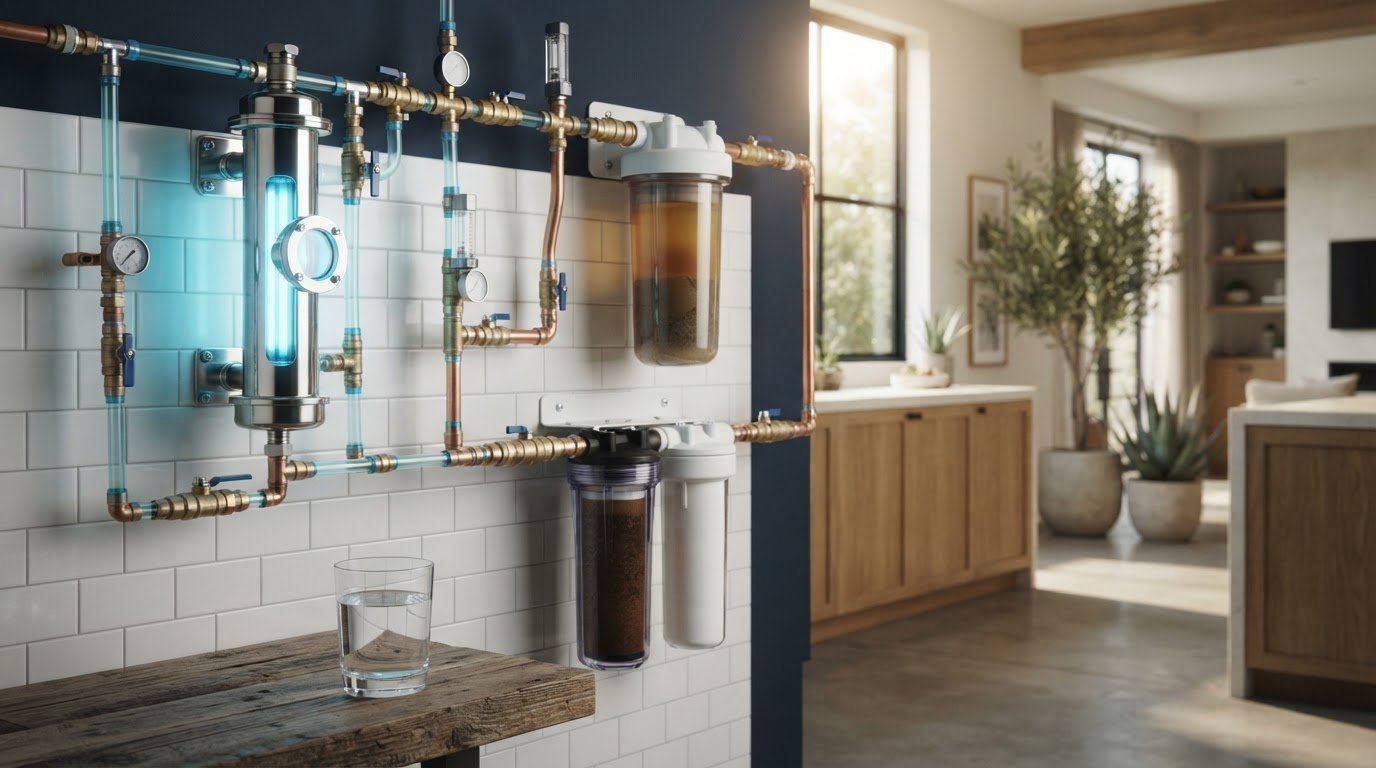
As water flows through a UV reactor, it passes a lamp that exposes it to UV-C light. This exposure can damage microorganisms’ genetic material and prevent susceptible organisms from reproducing. The technical term is UV disinfection. “Sterilizer” is common search terminology, but it doesn’t mean the system removes every contaminant or makes water sterile in every circumstance. Ultraviolet germicidal irradiation (UVGI) describes the science behind this process.
A UV system disinfects water by exposing it to ultraviolet light that inactivates susceptible microorganisms; it is not a complete water filtration system. UV doesn’t remove dissolved chemicals, metals, or sediment. Suspended particles can block light from reaching microorganisms, so water clarity matters.
Chemical disinfection introduces a treatment agent to control microorganisms. The agent, dose, contact time, and whether a disinfectant residual remains in the water depend on the method and system. A residual may provide protection as water travels through plumbing, while UV treatment leaves no disinfectant residual.
Disinfection is only one part of water treatment. It doesn’t automatically address taste and odor, minerals, sediment, or dissolved contaminants. Those concerns may call for separate treatment stages selected for the specific issue. Both UV and chemical disinfection have limits, so base your choice on test results and intended use, not the treatment label alone.
Neither method is a universal fit. A UV sterilizer relies on a functioning lamp and suitable water conditions; chemical disinfection depends on the treatment agent and how it’s applied. Compare the practical differences below, then check which requirements apply to your water and household.
| Factor | UV disinfection | Chemical disinfection |
|---|---|---|
| How it works | UV light inactivates susceptible microorganisms as water passes through a reactor. | A chemical agent controls microorganisms through a method-specific process. |
| Residual protection | Leaves no disinfectant residual in treated water. | Some methods may leave a residual; this varies by agent and treatment. |
| Operating needs | Requires a working lamp, suitable flow and sizing, and water clear enough for UV to reach microorganisms. | Requires following the method’s instructions for application, dosing, and any recommended monitoring. |
| Key limitations | Doesn’t remove chemical contaminants, dissolved minerals, or suspended particles. | Requirements and effects vary by method and water conditions; no single approach fits every source. |
For UV, check that the system is sized for the flow it must treat, the lamp is maintained as specified, and the water is clear enough for adequate exposure. Sediment or other suspended particles can interfere with that exposure. Chemical methods also require careful, method-specific use. The EPA’s guidance on emergency chemical disinfection explains options for emergency situations; household treatment choices should instead be based on water conditions and the system’s instructions.
UV may be worth considering if your goal is to inactivate susceptible microorganisms without adding a disinfectant through the UV process. Water testing and system design help determine whether it fits your needs. Compare the system’s rated flow with your household demand, and check whether pretreatment is needed to address clarity.
Consider how the treatment agent is applied, how dosing is managed, what monitoring is recommended, and whether the method leaves a residual. These details vary, so don’t assume an approach used in one setting is suitable for another. If UV seems relevant, review CastleGuard’s ultraviolet systems as an option to investigate, then confirm suitability for your water and household.
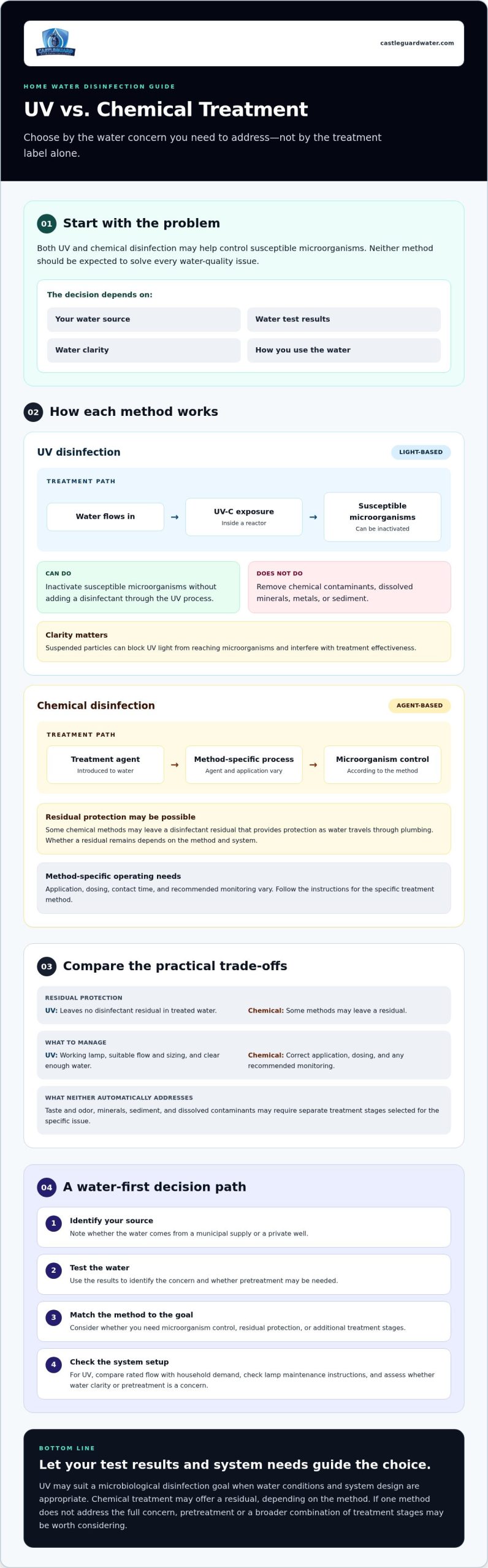
A sound choice starts with evidence, not equipment. Use this sequence to narrow your options:
Municipal-water users can review available water-quality information and consider whether additional treatment addresses a specific household concern. Well-water users should test their own supply rather than assume conditions match those of another well. Homeowners in Southern California, Nevada, Arizona, Texas, and Florida should also base decisions on their own source and test results, not on location alone. For more well-specific context, see this UV light for well water disinfection guide.
Choose testing that can identify the concern you want to address and help determine whether treatment stages are needed beforehand. If water looks cloudy or contains sediment, ask whether it needs upstream treatment. Particles can reduce UV transmission and interfere with disinfection. Clear-looking water alone doesn’t show which treatment it needs.
Compare your household’s peak flow demand with the system’s rated flow and design requirements. Use current manufacturer specifications rather than assumptions based on home size. Check that the installation location has access to power and enough room for lamp replacement, cleaning, and routine checks. These practical details help you determine whether a UV sterilizer suits both your water and your maintenance preferences.
Once you have your test results and treatment goal, ask CastleGuard about ultraviolet systems and confirm suitability, specifications, and support before choosing equipment.
Use your water-test results, treatment goal, system conditions, and maintenance preferences to guide your decision. UV may be one stage in a broader setup rather than a replacement for filters designed to address sediment, taste, odor, or other concerns. For more on system operation and selection, see the ultraviolet water filter system selection guide.
Before choosing a UV sterilizer, confirm what the unit is designed to address and whether your test results indicate a need for pretreatment. Then review the details that determine whether it can work in your home:
Check these points against current manufacturer specifications. A unit that doesn’t match your flow or water conditions may not be suitable, even if UV addresses your treatment goal.
CastleGuard sells ultraviolet systems for home water treatment. If you’re considering one, gather your water-test results and note your household’s flow needs, water conditions, and maintenance preferences. Contact CastleGuard’s customer support, available Monday through Friday, to ask whether its UV systems may fit your needs and confirm current specifications and availability. CastleGuard sells equipment but doesn’t provide professional installation.
Ready to explore the options? Ask CastleGuard about its ultraviolet systems and share the water concern you’re looking to address.
The right disinfection choice starts with your water, not a one-size-fits-all promise. Use test results to identify the concern, then consider whether UV or a chemical method fits your treatment goal, water conditions, household flow, and maintenance preferences. A uv sterilizer can address susceptible microorganisms, but it won’t replace filtration needed for sediment, dissolved chemicals, or other water-quality concerns.
Before choosing equipment, confirm system requirements and any pretreatment needs. CastleGuard offers ultraviolet systems as part of its home water treatment range, and its customer support is available Monday through Friday. Share your water-test results and household needs to ask whether a UV system may be suitable.
Ask CastleGuard about UV water treatment for your home. Share your water concern and ask about a system that may fit your needs.
Neither method is best for every home. A uv sterilizer can inactivate susceptible microorganisms when it’s properly sized and operated, but it won’t remove chemical contaminants or particles. Chemical disinfection methods differ in how they’re used and whether they leave a residual. Compare your water-test results and household needs with each system’s verified requirements before deciding.
No. UV treatment targets susceptible microorganisms; it doesn’t remove dissolved chemicals, minerals, sediment, or substances that affect taste and odor. If your water has an unpleasant taste or contains a specific contaminant, testing can help identify the right treatment goal. You may need a separate filtration stage, but confirm that it’s designed for the issue your results identify.
It may need pretreatment if sediment or cloudy water interferes with UV transmission. The right setup depends on your water quality and the unit’s design, so don’t assume every household needs the same filter. Test your water, check the manufacturer’s specifications, and confirm any pretreatment requirements before selecting equipment. Particles can block UV exposure and affect system performance.
Start with a water test and a clear treatment goal. Then check the unit’s rated flow against your household demand, along with water clarity, pretreatment needs, power access, and maintenance instructions. Confirm certification details and current availability with the seller. A uv sterilizer that doesn’t match your water conditions or flow requirements may not perform as intended.
UV may be an option for well-water disinfection, but suitability depends on test results, water clarity, flow, and correct system sizing. It won’t address every possible well-water concern, so additional treatment may be needed. Homeowners in Southern California, Nevada, Arizona, Texas, and Florida can review CastleGuard’s well-water UV disinfection guide for more context.