What if choosing a drinking water system for home starts with your local water information, not the filter aisle? If you’re unsure what’s in your tap water or how filtration differs from purification, comparing systems can quickly feel confusing. Start by identifying what you want the water to address, then look for a system whose documented capabilities match that need.
This guide explains common home drinking-water system types and how to use local water-quality information to narrow your options. You’ll also learn what to consider about ongoing care and replacement media before choosing a system. CastleGuard offers residential drinking water systems, and understanding your household’s priorities can help you make a practical, informed choice. The questions below can help you compare treatment scope, product information, and maintenance needs.
A drinking water system for home use treats water intended for drinking and cooking. It may serve a specific tap or drinking-water location rather than every faucet in the house. Treatment purpose and performance depend on the system’s design. Read its product documentation for the substances or water qualities it is designed to address, along with any relevant test or certification information.
Point-of-use treatment focuses on water at selected locations; whole-home treatment addresses water as it enters the house. This distinction helps define what you’re comparing, but neither approach is automatically better. The right scope depends on where you want treated water and what your household needs.
A point-of-use system treats water at one location, such as a dedicated drinking-water tap or another selected outlet. It may suit households focused on water for drinking and cooking. A whole-home system treats water at the home’s entry point, supplying treated water through the plumbing to multiple fixtures.
These approaches address different needs. If you’re considering broader treatment for city water, see our whole-house city-water guide for a closer look at that scope.
“Water filtration” and “water purification” can describe different processes. Neither term alone promises that every concern is addressed. For an overview of treatment methods, see Water purification. Then check the system’s documentation to understand its intended purpose and limits. A general label won’t tell you whether a system matches a particular water-quality result or household priority.
CastleGuard offers residential drinking water systems. As you compare options, match their documented capabilities to the water you use and the outcome you’re seeking. This is a more useful starting point than choosing based on broad claims alone.
Different treatment methods serve different purposes. Compare the technology and its documented performance rather than relying on a broad label. Consider a drinking water system for home in relation to the specific water concern you want to address.
Treatment performance depends on the specific system and target contaminant, not simply on the technology’s name. CastleGuard offers residential drinking water systems. Explore CastleGuard drinking water systems as you compare options.
Your local utility’s latest Consumer Confidence Report is a useful starting point for reported water-quality information. It describes system-wide results, but conditions can differ by household because of plumbing or other local factors. A household water test to identify heavy metals may help investigate a particular concern. Neither a report nor a screening result proves the presence or absence of every possible contaminant.
NSF and ANSI standards can help you interpret product documentation, but the exact standard and claim matter. For example, NSF/ANSI 42-2025 covers aesthetic effects such as taste and odor, while NSF/ANSI 53-2025 addresses systems designed to reduce certain health-related contaminants. Don’t assume every system is certified or that one certification means the same substances are addressed. Match the stated scope to the specific concern you’re evaluating.
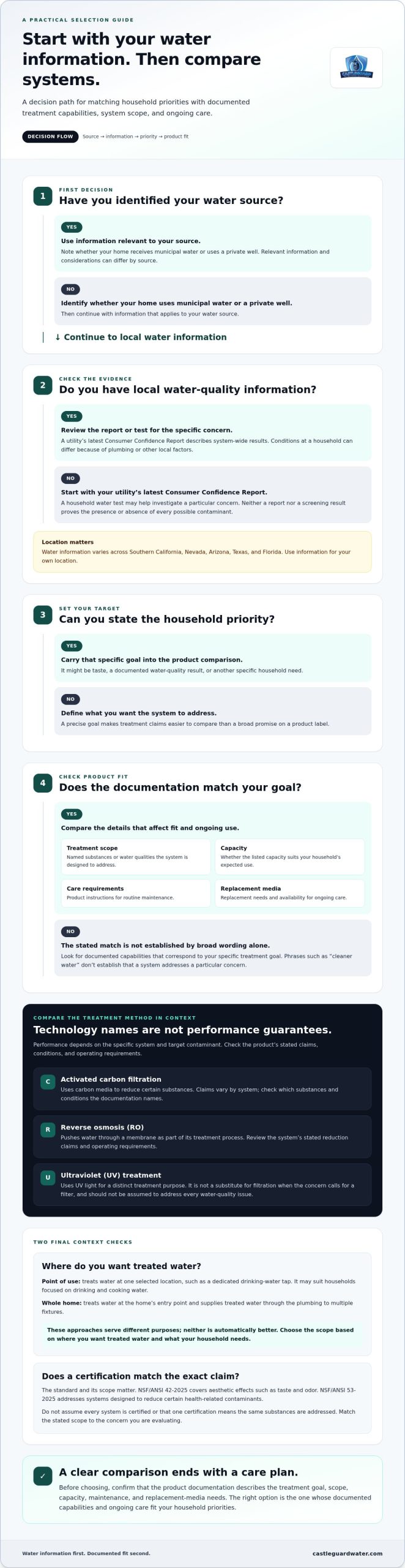
Start with your household’s specific concern, not a broad promise on a product label. Follow these steps to narrow the options and compare systems more clearly:
Read the product documentation closely. The stated capability should correspond to the treatment goal you identified, and the manufacturer’s instructions should explain maintenance and replacement needs. Consider whether the listed capacity suits your household’s use and whether replacement media are available for ongoing care. Phrases such as “cleaner water” don’t establish that a particular system addresses a specific concern.
CastleGuard offers residential drinking water systems. Review product information alongside your household priorities to make a more informed choice about a drinking water system for home.
Explore CastleGuard drinking water systems and compare documented capabilities with your practical ownership needs.
Choosing a system is only part of the plan. A drinking water system for home also needs care suited to the specific product. Replacement timing and maintenance steps vary, so follow the manufacturer’s instructions rather than applying a schedule intended for a different system.
Keep the product documentation somewhere easy to find, and note recommended service or replacement dates on a calendar. Check which replacement media the system uses and how to identify the correct type. A simple record helps you keep up with routine care without guessing at intervals.
Your water source matters when reviewing relevant information. Municipal water and private well water can have different information available and may call for different considerations. If your home uses a well, CastleGuard’s well-water treatment guide provides more source-specific context. CastleGuard also provides customer support Monday through Friday.
Set realistic expectations: don’t assume a single system addresses every water concern. Its role depends on the product’s documented treatment scope and the issue you’re trying to address. If your concern changes, revisit the relevant water information and compare it with the system documentation rather than assuming your original choice covers a new need.
CastleGuard offers residential drinking water systems for homeowners considering treatment for drinking water. Review product information alongside your household’s priorities and care routine. Understanding a system’s intended use and upkeep can make ownership more manageable.
Explore CastleGuard drinking water systems to consider a practical next step for your home.
Choosing a drinking water system for home starts with matching your household’s priorities to the system’s documented treatment scope. Compare filtration, reverse osmosis, and UV by their distinct purposes, then use local water information to narrow your focus. Before deciding, consider product capacity, care instructions, and replacement-media needs. Don’t assume one system addresses every water concern.
Plan for ongoing care, too. Keep the manufacturer’s instructions handy and track recommended replacement dates. CastleGuard offers residential drinking water systems, automatic filter deliveries, and weekday customer support to help make routine care easier to manage.
Ready to explore an option for your household? Explore CastleGuard drinking water systems and compare the product information with your needs.
The best system is the one whose documented treatment capabilities match your water information and household priorities. Start by identifying whether you want to address taste, a specific water-quality result, or another need. Then compare the system’s stated scope, capacity, and care requirements. A drinking water system for home use isn’t automatically the right fit for every concern, so review product-specific documentation before deciding.
Not necessarily. Whether you want additional treatment depends on your priorities and the information available about your water. Start with your local utility’s latest Consumer Confidence Report, then consider whether taste or a specific household concern leads you to explore a system. Water information varies across Southern California, Nevada, Arizona, Texas, and Florida, and system-wide reports may not reflect conditions inside your home’s plumbing.
A drinking water system typically treats water at a selected drinking or cooking location, while a whole-house filter treats water as it enters the home and supplies multiple fixtures. They serve different purposes, so neither is universally better. Consider whether your priority is water at one tap or treatment throughout the home, then compare each system’s documented purpose and capabilities.
Reverse osmosis alone doesn’t guarantee that water is safe to drink. Performance depends on the specific system, its documented reduction claims, and the substances you’re concerned about. Review the product’s scope and any relevant certification information, then compare them with available water-quality information. Don’t assume every reverse osmosis system addresses every contaminant or household water concern.
Follow the manufacturer’s instructions for the specific system, because replacement timing depends on the product and its use. Keep the documentation handy and record recommended replacement dates to make routine care easier to track. CastleGuard offers automatic filter deliveries and customer support Monday through Friday. Use these resources alongside the product’s directions to determine when its filter or other replacement media needs attention.